How to Earn Money with AI-Generated Music Using Freebeat in 2026
This guide contains affiliate links. If you sign up through our links, we may earn a commission at no extra cost to you. We only recommend tools we've thoroughly researched.

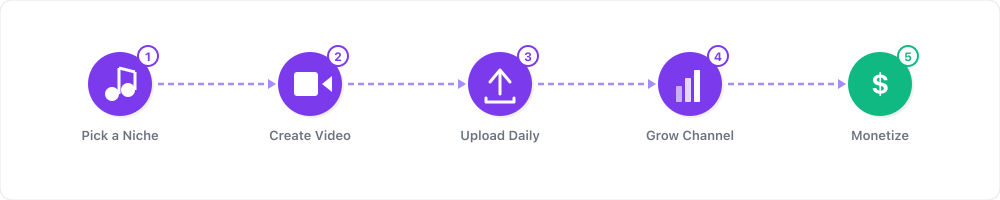
Why AI Music Is the Most Overlooked Income Opportunity in 2026
The music industry is undergoing a fundamental shift. AI-generated music is no longer a novelty — it is a legitimate production tool that creators are using to build real businesses. Faceless music channels, lo-fi beat playlists, ambient soundscapes, and AI-generated tracks on streaming platforms are generating meaningful revenue for creators who have never touched an instrument.
Here is why the timing is exceptional:
- The global creator economy is valued at over $250 billion in 2026, with audio and music content as one of its fastest-growing segments
- YouTube's lo-fi and ambient music category generates billions of monthly views — and the vast majority of these channels use royalty-free or AI-generated tracks
- Spotify alone has over 600 million active users, and the platform's algorithmic playlists actively surface new music regardless of the artist's following
- The barrier to entry has collapsed. Tools like Freebeat let you generate original, royalty-free tracks in minutes — no music theory, no instruments, no production software
The economics are straightforward. A faceless YouTube music channel with 50,000 monthly views earns $200–800/month from ads alone. Add Spotify streaming royalties, affiliate commissions, and licensing deals, and the same content library generates $500–2,000+/month across platforms — all from tracks you created in minutes using AI.
The critical advantage: unlike traditional music production, AI music scales linearly with your time investment. Every hour you spend generates 6–12 publishable tracks. A traditional producer might spend the same hour on a single track. This volume advantage is what makes the business model work.
What You Need to Get Started
| Item | Cost | Purpose |
|---|---|---|
| Freebeat account (free tier) | $0 | Generate your first tracks and test the platform |
| YouTube account | $0 | Primary distribution and ad revenue platform |
| Spotify distributor (DistroKid or TuneCore) | $20–25/year | Distribute tracks to streaming platforms |
| Simple image editor (Canva free) | $0 | Create thumbnails and visual branding |
| Freebeat Creator plan (when scaling) | $9.99/mo | 50 tracks/month, HD export, no watermark |
| Freebeat Pro plan (for volume) | $24.99/mo | Unlimited tracks, 4K export |
Total startup cost: $0. The free tier gives you 5 tracks per month — enough to launch your channel and test which genres resonate with audiences.
Time investment: 5–10 hours per week for content generation, uploading, and channel management. This decreases as you build batch workflows.
Skill level: Zero musical ability required. If you can type a description of the mood and genre you want, Freebeat handles composition, arrangement, and mixing automatically. If you can upload a file to YouTube, you can run a music channel.
Step 1: Choose Your Music Niche and Channel Identity

Not all music niches are created equal. Some generate passive views for years (study music, sleep sounds), while others trend and fade (specific EDM subgenres). Choose a niche with proven long-term demand.
Most profitable faceless music niches in 2026:
| Niche | Demand Level | Competition | Revenue Potential | Listen Behavior |
|---|---|---|---|---|
| Lo-fi hip hop / study beats | Very high | High | Very high | Background, hours-long sessions |
| Ambient / relaxation / spa | High | Medium | High | Background, sleep, meditation |
| Synthwave / retrowave | Medium | Low | Medium-High | Active and background listening |
| Jazz / coffee shop | High | Medium | High | Background, work sessions |
| Classical piano / instrumental | Medium-High | Medium | Medium | Study, relaxation |
| Workout / gym / EDM | Medium | Medium | Medium | Active listening, short sessions |
| Sleep sounds / white noise | Very high | High | High | 8+ hour sessions, massive watch time |
| Cinematic / epic / trailer music | Medium | Low | Medium-High | Active listening + licensing potential |
The key insight: Background music niches (lo-fi, ambient, sleep, study) generate enormously long watch sessions. A listener who plays your 2-hour lo-fi mix while studying generates 2 hours of watch time — YouTube rewards this with aggressive algorithmic promotion. This is why music channels can grow faster than most other content types.
Channel identity essentials:
- Channel name that immediately communicates the genre: "Midnight Lounge Beats," "Deep Focus Ambient," "Synthwave Station"
- Consistent visual aesthetic across all thumbnails, banners, and video imagery
- Channel description optimized with keywords your target audience searches for
Step 2: Generate Your First Batch of Tracks
With your niche selected, it is time to create content. The Freebeat workflow is designed for volume — you should aim to generate 10-15 tracks in your first session.
Step-by-step generation process:
- Log in to Freebeat and navigate to the music generator
- Describe your track: Specify genre, mood, tempo, and energy level. Be specific — "calm lo-fi hip hop beat with vinyl crackle, soft piano, and slow drums at 75 BPM" produces better results than "lo-fi music"
- Generate and preview: Listen to the full track. Freebeat produces unique, royalty-free compositions each time
- Generate visuals: Use Freebeat's AI visual generator to create synchronized visuals that react to the beat and melody
- Export: Download in the highest quality available for your plan
- Repeat: Generate 10-15 tracks in a single batch session. This gives you 2+ weeks of content
Quality control checklist for each track:
- Does the track match the genre and mood you intended?
- Is the audio clean — no artifacts, abrupt transitions, or jarring elements?
- Do the visuals sync well with the music's energy?
- Would you listen to this while studying/working/exercising? (Honest self-assessment)
Pro tip: Generate more tracks than you need and curate the best ones. If you generate 15 tracks, publish the best 10. Quality control is what separates channels that grow from channels that stagnate.
Weekly Content Calendar for Music Channels
Use this template to plan your publishing schedule:
Monday: Upload 1 single track (10-15 minutes) — new release for the week
- Title format: "[Mood] [Genre] — [Evocative Name]" (e.g., "Peaceful Lo-Fi Beats — Late Night Study Session")
- Optimized thumbnail with consistent branding
- Full description with keywords, timestamps, and affiliate links
Wednesday: Upload 1 single track (10-15 minutes) — second release
- Different mood or variation within your niche
- Cross-promote Monday's track in the end screen
Friday: Upload 1 compilation mix (1-3 hours) — the week's tracks combined
- Title format: "[Duration] of [Genre] — [Use Case]" (e.g., "3 Hours of Lo-Fi Beats — Study, Work, Relax")
- These long mixes generate massive watch time and dominate algorithmic recommendations
Saturday: Post 2-3 YouTube Shorts (30-60 second clips from your best tracks)
- Shorts drive discovery and funnel listeners to your full-length content
Sunday: Distribute the week's tracks to Spotify via DistroKid
- Each track becomes a separate single on streaming platforms
Monthly: Create one "mega mix" (4-8 hours) of your best tracks from the month
- These ultra-long compilations can generate 100,000+ views over time
Video Idea Generator for Music Channels
Use these frameworks to never run out of content ideas:
Seasonal/Situational:
- "[Season] [Genre] Mix" (e.g., "Autumn Lo-Fi Beats," "Summer Synthwave Mix")
- "[Activity] Music" (e.g., "Coding Music," "Morning Coffee Jazz," "Late Night Drive Synthwave")
- "[Weather] [Genre]" (e.g., "Rainy Day Lo-Fi," "Snowy Evening Piano")
Time-Based:
- "[Duration] of [Genre]" (1 hour, 2 hours, 3 hours, 8 hours)
- "24/7 [Genre] Radio — Live Stream" (premium strategy for established channels)
Mood-Based:
- "Music for [Emotion]" (focus, relaxation, motivation, melancholy, nostalgia)
- "[Adjective] [Genre] Playlist" (chill, dark, uplifting, ethereal, heavy)
Trending:
- "[Year] [Genre] Mix" (e.g., "Best Lo-Fi Beats 2026")
- "[Pop Culture Reference] Style [Genre]" (e.g., "Blade Runner Style Synthwave")
Step 3: Optimize for YouTube Growth
Music channels grow differently than traditional content channels. The algorithm favors watch time above all else — and music content naturally generates enormous watch time because listeners leave it playing for hours.
YouTube optimization for music channels:
Titles: Include the genre, mood, and use case. "Lo-Fi Hip Hop — Beats to Study/Relax To" is the gold standard format because it includes keywords people actually search for.
Thumbnails: Consistent aesthetic across all videos. Use the same color palette, font, and visual style. Music channel viewers recognize consistency and are more likely to click on a familiar visual brand.
Descriptions: 200+ words with natural keyword variations. Include: genre keywords, mood keywords, use-case keywords ("study music," "work music," "sleep music"), and links to your other platforms and affiliate links.
Playlists: Organize your tracks into playlists by mood, genre, and use case. Playlists keep viewers on your channel longer, boosting total watch time.
End screens: Always link to your longest compilation mix and a thematic playlist. The goal is to keep the listener on your channel as long as possible.
Step 4: Distribute to Streaming Platforms
YouTube is your primary revenue platform, but streaming services add a meaningful second income stream from the same content.
Distribution setup:
- Sign up for DistroKid ($22.99/year) or TuneCore ($29.99/year for unlimited singles)
- Upload each track as a separate single with proper metadata (title, genre, mood tags)
- Create an artist profile on Spotify, Apple Music, and Amazon Music
- Submit tracks to Spotify's algorithmic playlists through Spotify for Artists
- Release consistently — Spotify's algorithm rewards regular uploads, just like YouTube
Streaming revenue expectations:
- Spotify pays approximately $0.003-0.005 per stream
- At 10,000 monthly streams: $30-50/month
- At 100,000 monthly streams: $300-500/month
- At 1,000,000 monthly streams: $3,000-5,000/month
These numbers seem small individually, but they compound. Every track you publish continues generating streams indefinitely. After 12 months of consistent publishing, you have 50-100+ tracks all generating passive streaming revenue simultaneously.
Step 5: Scale with Multi-Platform Distribution
The same AI-generated content works across every major platform. Maximize the value of every track you create.
Platform-specific strategies:
| Platform | Content Format | Revenue Model | Time to First Revenue |
|---|---|---|---|
| YouTube (long-form) | 1-8 hour mixes | Ad revenue ($3-10 CPM) | 2-4 months |
| YouTube Shorts | 30-60 sec clips | Shorts ad revenue | 2-4 months |
| Spotify/Apple Music | Individual tracks | Streaming royalties | 1-2 months |
| TikTok | 30-60 sec clips | Creator fund + traffic to YouTube | Immediate |
| Instagram Reels | 30-60 sec clips | Traffic to YouTube | Immediate |
| Licensing marketplaces | Full tracks | Per-license fees ($10-100+) | Variable |
The compounding effect: After 6 months of consistent publishing, you might have 60-80 tracks distributed across 5+ platforms. Each track generates its own small revenue stream. Combined, these micro-incomes create a meaningful and growing passive income portfolio.
Real-World Examples and Case Studies
The Lo-Fi Empire Model Channels like "Lofi Girl" have demonstrated that AI-assisted music channels can reach millions of subscribers and generate substantial revenue. While Lofi Girl uses human-curated tracks, the model is directly replicable with AI-generated music. Dozens of smaller channels in the 10,000-100,000 subscriber range earn $1,000-5,000/month using AI-generated tracks combined with simple looping visuals.
The Multi-Platform Creator A growing number of creators distribute the same AI-generated tracks across YouTube, Spotify, Apple Music, and TikTok simultaneously. By publishing 3-5 tracks per week across all platforms, these creators build diversified revenue streams that are resilient to any single platform's algorithm changes.
The Licensing Opportunity Content creators, podcasters, and small businesses need affordable background music constantly. AI-generated tracks listed on royalty-free marketplaces can generate $10-100+ per license, creating an additional passive income stream from the same content.
Revenue Projection Table
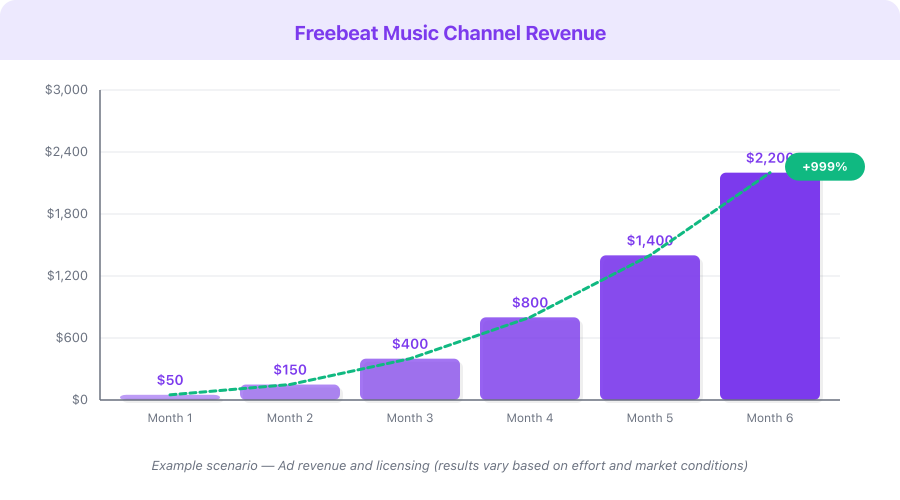
Disclaimer: The following table presents an Example Scenario for illustrative purposes only. Actual results vary significantly based on niche, content quality, consistency, audience engagement, and market conditions. These figures are not guarantees or promises of income.
This is a hypothetical example based on publicly available data, not a guarantee of results. Individual results vary significantly.
| Scenario | Tracks/Week | Monthly YouTube Views | YouTube Revenue | Streaming Revenue | Total Monthly |
|---|---|---|---|---|---|
| Conservative (1 channel, 3 tracks/week, Month 6) | 12 | 20,000-50,000 | $80-250 | $20-50 | $100-300 |
| Moderate (1 channel, 5 tracks/week + Spotify, Month 12) | 20 | 80,000-200,000 | $400-1,200 | $100-300 | $500-1,500 |
| Aggressive (2 channels, daily publishing + multi-platform, Month 18) | 30+ | 300,000-800,000 | $1,500-5,000 | $300-1,000 | $1,800-6,000 |
Revenue sources include YouTube AdSense, Spotify/Apple Music streaming royalties, affiliate commissions, and licensing fees. Ranges reflect niche variation and seasonal fluctuations.
Monetization Strategies
1. YouTube Ad Revenue ($80-5,000/month)
Music channels earn through YouTube's ad revenue share. Long compilation mixes (1-8 hours) are particularly profitable because they generate enormous watch time and allow multiple mid-roll ad placements. A 3-hour lo-fi mix with 50,000 views can earn $200-500 in ad revenue — and it continues earning every month as listeners return.
2. Spotify and Streaming Royalties ($20-1,000/month)
Distribute your AI-generated tracks to Spotify, Apple Music, Amazon Music, and 150+ other platforms through DistroKid ($22.99/year). Each stream earns a small royalty, but the compounding effect of 50-100+ tracks all generating streams simultaneously creates meaningful passive income. Focus on getting tracks into Spotify's algorithmic playlists by using accurate genre tags and releasing consistently.
3. Freebeat Affiliate Commissions (20% Recurring, 30-Day Cookie)
Every viewer who signs up for Freebeat through your link earns you 20% of their subscription for as long as they remain a paying customer. If you mention Freebeat in your video descriptions and tutorials, referrals accumulate over time. 20 referrals on the Creator plan ($9.99/month) generates $40/month in passive recurring income.
4. Background Music Licensing ($10-100+ per license)
List your AI-generated tracks on royalty-free marketplaces like Pond5, AudioJungle, or Artlist. Content creators, podcasters, and businesses purchase licenses for background music constantly. A catalog of 50+ tracks can generate $100-500/month in licensing revenue with zero ongoing effort.
5. Channel Sponsorships ($200-2,000 per deal)
Once your channel reaches 10,000+ subscribers, music-related brands (headphone companies, streaming services, music software) will approach you for sponsored mentions. Music channels are attractive to sponsors because the audience is engaged and the content is brand-safe.
Pricing Breakdown with ROI Calculation
| Plan | Monthly Cost | Tracks/Month | Video Export | Best For |
|---|---|---|---|---|
| Free | $0 | 5 | Watermarked | Testing, first tracks |
| Creator | $9.99/mo | 50 | HD, no watermark | Active single channel |
| Pro | $24.99/mo | Unlimited | HD + 4K | Multi-channel, high volume |
ROI calculation for Creator plan ($9.99/month):
- Generate 20 tracks per month (using 40% of capacity)
- Publish 3 videos per week on YouTube (singles + compilations)
- At 30,000 monthly views (achievable within 4-6 months): $120-300/month in ad revenue
- Add streaming royalties: $20-50/month
- Total: $140-350/month against $9.99 in costs
- ROI: 1,300-3,400%
Affiliate commission rate: 20% recurring with a 30-day cookie window. Every referral generates ongoing passive income for the lifetime of their subscription.
Break-even point: A channel generating just 3,000-5,000 monthly views earns enough ad revenue to cover the Creator plan. Most channels surpass this within the first 6-8 weeks of consistent publishing.
Common Mistakes to Avoid
-
Inconsistent publishing schedule. The YouTube algorithm rewards consistency above almost everything else. Missing days breaks momentum and signals to the algorithm that your channel is unreliable. Set a publishing schedule and stick to it — even if individual tracks are not perfect.
-
Only publishing short tracks. Single 10-minute tracks are fine, but the real revenue comes from long compilations (1-8 hours). These generate massive watch time, trigger YouTube's recommendation engine, and allow multiple mid-roll ads. Always compile your weekly tracks into a longer mix.
-
Generic, unsearchable titles. "AI Music #47" tells the algorithm and viewers nothing. Use descriptive, keyword-rich titles: "3 Hours of Chill Lo-Fi Beats — Study, Work, Relax | 2026 Mix." Include the genre, mood, use case, and duration.
-
Ignoring visual branding. Even for music channels, thumbnails and visual consistency matter. Listeners browse by thumbnail, and a cohesive visual brand builds recognition and trust. Create a template in Canva and use it for every video with minor variations.
-
Not distributing to streaming platforms. YouTube should be your primary platform, but leaving your tracks off Spotify, Apple Music, and Amazon Music means leaving money on the table. Distribution through DistroKid costs $22.99/year — the ROI is obvious.
-
Giving up before Month 3. Music channels have a slow start because the algorithm needs data to understand your content and audience. Most channels see their first real growth spike between weeks 6-12 of consistent daily or near-daily publishing. The creators who quit at week 4 never see the payoff.
-
Ignoring YouTube Shorts entirely. Short 30-60 second clips of your best tracks serve as discovery content, funneling new listeners to your full-length videos. Cross-post these clips to TikTok and Instagram Reels for additional reach at zero extra production cost.
Quick Start Checklist
- Sign up for Freebeat free — no credit card required
- Choose your music niche from the table above (lo-fi, ambient, synthwave, etc.)
- Generate your first 5 tracks — experiment with different moods and tempos
- Create a YouTube channel with a genre-specific name and consistent visual branding
- Upload your first 3 tracks as individual videos with optimized titles and descriptions
- Create a 1-hour compilation mix from your first 5 tracks
- Post 2 YouTube Shorts (30-second clips of your best tracks)
- Sign up for DistroKid ($22.99/year) and distribute your tracks to Spotify
- Set up a Spotify for Artists profile and submit tracks to algorithmic playlists
- Establish a weekly publishing schedule using the content calendar template above
- Join the Freebeat affiliate program (20% recurring commission)
- After 4 weeks, review analytics and double down on the genres and moods that generate the most watch time
Frequently Asked Questions
Can I monetize AI-generated music on YouTube and Spotify?
Yes. AI-generated music created with Freebeat is royalty-free and cleared for commercial use on all paid plans. You own the output and can monetize it through ad revenue, streaming royalties, and licensing. YouTube does not penalize AI-generated music content — the algorithm treats it the same as any other music channel.
How many tracks do I need before my channel starts growing?
Most music channels see meaningful growth after publishing 20-30 tracks (including compilations) over 4-8 weeks. The compilation mixes are particularly important for growth because they generate the watch time signals that YouTube's algorithm rewards. Aim for at least one long-form compilation per week in addition to individual track uploads.
Will listeners care that the music is AI-generated?
For background listening niches (study music, sleep sounds, ambient, lo-fi), listeners care about the mood and quality of the music — not how it was produced. These listeners are pressing play and then studying, working, or sleeping. They are not analyzing production credits. Focus on generating tracks that genuinely serve the intended use case, and the audience will come.
How does Freebeat compare to making music with traditional production software?
Freebeat eliminates the learning curve entirely. Traditional music production (Ableton, FL Studio, Logic Pro) requires months of learning before you can produce a listenable track. Freebeat lets you generate a publish-ready track in minutes with zero musical knowledge. The tradeoff is less granular control — you cannot edit individual notes or layers. For faceless music channels, this tradeoff heavily favors Freebeat's speed advantage.
Can I run multiple music channels in different genres?
Absolutely, and this is one of the most effective scaling strategies. Once your first channel is established (1,000+ subscribers, consistent publishing rhythm), launch a second channel in a complementary niche. A lo-fi beats channel and a synthwave channel can share production workflows while reaching completely different audiences. The Freebeat Pro plan ($24.99/month for unlimited tracks) makes multi-channel operation economically viable.
What's Next
You have the complete framework for building a profitable AI music content business with Freebeat. Here is your path forward:
- This week: Generate your first 5 tracks and publish 3 videos on YouTube
- This month: Build to a consistent 3-video-per-week schedule with weekly compilations
- Month 2: Distribute your catalog to Spotify and start building streaming revenue
- Month 3-4: Hit YouTube monetization, join the affiliate program, and start earning from ads
- Month 6+: Scale to daily publishing, explore a second channel, and build licensing income
Related resources on income.tools:
- Freebeat Review — full feature breakdown and honest assessment
- Freebeat Channel Guide — detailed channel setup walkthrough
- ElevenLabs Guide — add AI voiceover narration to your music videos
- Opus Clip Guide — repurpose your music content into viral Shorts
The creators earning $1,000-5,000/month from AI music channels all started with a single generated track. The only difference between them and everyone else is that they published it — and then published the next one.
Start with Freebeat free — your first AI-generated track is 5 minutes away.