How to Build and Sell a Micro-SaaS with Lovable in 2026
This guide contains affiliate links. If you sign up through our links, we may earn a commission at no extra cost to you. We only recommend tools we've thoroughly researched.
Why No-Code SaaS Building Works in 2026
The software industry has fundamentally shifted. Building a web application used to require months of development time, $10,000–100,000+ in engineering costs, and deep technical expertise. In 2026, you can describe an app in plain English and have a working, deployable product in an afternoon — thanks to AI-powered builders like Lovable.
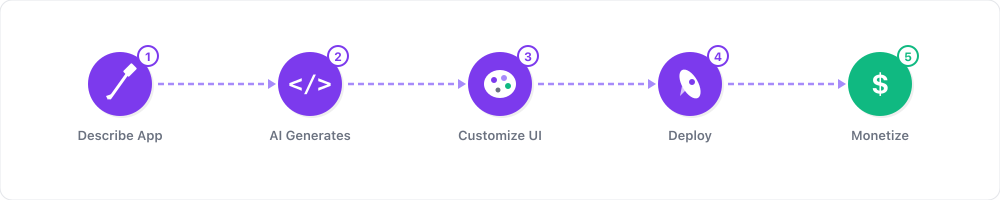
Lovable has reached $200M ARR, proving that the demand for AI-built software is massive and growing. The platform generates production-ready React applications with modern UI components, database integration (via Supabase), user authentication, and API connections — all from natural language prompts. You describe what you want, Lovable writes the code, designs the interface, and deploys it.
The opportunity is enormous for two reasons. First, millions of niche problems still lack software solutions. Big tech companies build for broad markets — they'll never create a booking tool specifically for mobile dog groomers or an inventory tracker for vintage vinyl shops. These micro-niches are perfectly sized for one-person SaaS businesses. Second, the economics have flipped. When building costs $20–50/month instead of $50,000, you can profitably serve markets of 50–200 customers that were previously too small to justify development investment.
Real companies are already proving this model. Lumoo, built with Lovable, reached $800K ARR within just 9 months of launch. Imaginary Space hit $100K per month in revenue. These aren't Silicon Valley startups with venture capital — they're lean products built by small teams using AI tools. The playbook is clear, repeatable, and accessible to anyone willing to put in the work.
What You Need to Get Started
- A Lovable account — free tier with 5 generations/day, Starter at $20/month for unlimited generations
- A problem worth solving — a specific pain point experienced by a findable audience willing to pay $9–49/month
- A Supabase account (free) — for database, authentication, and real-time features
- A Stripe account (free to create) — for collecting subscription payments
- Basic product sense — you don't need to code, but you need to think clearly about what users need
- A distribution channel — a community, platform, or audience where your target users already gather
- Time investment: 1–2 weekends for MVP, 5–10 hours/week ongoing
- Budget: $0–50/month to start (Lovable free tier + Supabase free tier + your time)
No programming languages to learn. No frameworks to configure. No servers to manage. If you can write clear sentences describing what you want your app to do, you can build with Lovable.
Step 1: Find a Micro-SaaS Idea That People Will Pay For

A micro-SaaS is a small, focused software product that solves one specific problem for a niche audience. The best ideas come from real pain points — not from brainstorming in isolation.
Where to find validated ideas:
- Your own work frustrations. What manual process do you repeat weekly that a simple tool could automate? What spreadsheet are you maintaining that should be an app?
- Reddit and online forums. Search r/SaaS, r/smallbusiness, r/Entrepreneur, and niche subreddits for phrases like "I wish there was a tool for..." or "is there software that..." Each of these posts is a potential product idea from a real person with a real problem.
- Existing tool gaps. Use a popular tool daily? What feature is missing or poorly implemented? Building a better version for a specific niche is one of the most reliable SaaS strategies.
- Niche professional communities. Join Facebook groups, Slack channels, and Discord servers for specific professions — veterinarians, real estate agents, yoga instructors, wedding planners. Listen to their complaints about software. Their frustrations are your roadmap.
Proven micro-SaaS categories with strong demand:
| Category | Example Product | Target Customer | Price Range |
|---|---|---|---|
| Booking & scheduling | Appointment system for mobile pet groomers | Service providers | $19–39/mo |
| Client management | Simple CRM for freelance photographers | Freelancers | $15–29/mo |
| Niche calculators | ROI calculator for Airbnb hosts | Property investors | $9–19/mo |
| Workflow automation | Invoice generator for construction contractors | Small businesses | $19–49/mo |
| Content tools | Social media scheduler for real estate agents | Agents & brokers | $19–39/mo |
| Community management | Member directory for coworking spaces | Space operators | $29–49/mo |
Validation before building. Before spending a weekend building, validate that people will pay:
- Post in the target community asking if anyone experiences the problem
- Create a quick landing page with Mixo describing the solution and collect email signups
- If 5%+ of visitors sign up, the idea has demand. If less than 1% convert, keep looking.
Step 2: Design Your MVP Ruthlessly
MVP stands for Minimum Viable Product — the simplest version that delivers the core value. This is where most first-time builders fail. They try to build everything and ship nothing.
The MVP rules:
- One core feature that solves the primary problem. Not three features. One.
- User authentication (Lovable + Supabase handles this automatically)
- A clean, intuitive interface (Lovable's generated UI is already professional)
- A way to collect payment (Stripe integration)
- Nothing else. Every additional feature delays your launch and may be something users don't even want.
Example of ruthless MVP scoping:
Idea: A client management tool for freelance wedding photographers
Full vision: Client database, contract generation, invoice management, shoot scheduling, gallery delivery, automated email reminders, mood board collaboration, payment tracking, expense logging, tax report generation
MVP: A dashboard where photographers add clients, attach shoot dates, and send one-click invoice links. That's the entire product at launch.
The rest gets built after you have paying users telling you what they need next. Building features in advance is guessing. Building features on request is product development.
Step 3: Build Your App with Lovable
Go to Lovable and describe your app in detail. The quality of your output depends heavily on the quality of your prompt.
Prompt engineering for Lovable:
A weak prompt: "Build me a CRM." This gives Lovable almost nothing to work with.
A strong prompt: "Build a client management tool for freelance wedding photographers. The main dashboard shows a list of clients with columns for client name, wedding date, venue, package selected, and payment status. Users can click 'Add Client' to open a form with fields for client name, email, phone, wedding date, venue name, and package type (dropdown: Silver, Gold, Platinum). Each client row is clickable and opens a detail page showing all client info plus a button to generate and send a Stripe invoice link. Include user authentication with email/password login. Use a clean, modern design with a warm neutral color palette."
The iterative building process:
After Lovable generates the initial app, refine it through conversation:
- "Add a calendar view on the dashboard that shows upcoming weddings plotted by date"
- "Add a notes field on the client detail page where the photographer can save shoot preferences"
- "Add a status badge on each client row — 'Inquiry,' 'Booked,' 'Deposit Paid,' 'Complete'"
- "Connect Stripe so the 'Send Invoice' button generates a real payment link"
- "Add a simple analytics card at the top of the dashboard showing total revenue this month and number of active clients"
Realistic building timeline:
| Phase | Time | What Happens |
|---|---|---|
| Initial generation | 15–30 min | Describe the app, review the generated output, identify gaps |
| Core iteration | 2–4 hours | Refine features, fix UI issues, add missing functionality through prompts |
| Database setup | 30–60 min | Configure Supabase tables, set up authentication, test data persistence |
| Stripe integration | 30–60 min | Connect payment processing, test subscription billing flow |
| Testing & polish | 1–2 hours | Test all user flows, fix edge cases, improve mobile responsiveness |
| Total | 5–8 hours | A working, deployable MVP |
Most people can build their MVP over a single weekend. Compare that to the traditional development timeline of 2–6 months and $10,000–50,000+ in costs.
Step 4: Launch and Acquire Your First 10 Customers
The first 10 customers are the hardest and most important. They validate your product, provide feedback, and become your first case studies.
Pre-launch (1 week before):
- Create a landing page describing the product and its core benefit (use Mixo for speed)
- Post in 3–5 communities where your target users hang out, asking for beta testers
- Set up a simple pricing page — start with one plan at $29/month (don't overcomplicate with tiers yet)
- Prepare a launch post with screenshots, a demo video (record a 2-minute Loom), and a clear description of who it's for
Launch channels (use all of them in the first week):
| Channel | What to Post | Expected Results |
|---|---|---|
| Product Hunt | Full product page with screenshots, video, and maker story | 100–500 visitors, 5–20 signups |
| Reddit (niche subs) | "I built a [tool] for [audience] — looking for feedback" | 50–300 visitors, 3–15 signups |
| Twitter/X | Building-in-public thread showing the journey from idea to launch | 200–1,000 impressions, 5–20 signups |
| Hacker News (Show HN) | Technical description of what you built and how | 100–2,000 visitors (highly variable) |
| Niche Facebook groups | Genuine post about solving the problem, with link | 30–100 visitors, 5–15 signups |
| Indie Hackers | Full launch writeup with revenue goals and strategy | 50–200 visitors, 3–10 signups |
Post-launch (first 30 days):
- Respond to every piece of feedback within 24 hours — speed builds loyalty
- Fix bugs immediately. Nothing kills an early-stage product faster than broken features
- Add features based on what paying users request, not what you think is cool
- Ask every happy user for a testimonial. You need 5–10 testimonials for your landing page
- Email your early users weekly with updates on what you've shipped
SaaS Client Proposal / Launch Announcement Template:
Subject: I built [Tool Name] to solve [specific problem] for [target audience]
Hey [community/name],
I'm a [your role/background] and I kept running into the same problem: [describe the pain point in 1-2 sentences from the user's perspective].
I looked for a tool that would [what the ideal solution does], but everything I found was either [too expensive / too complex / built for enterprises / missing key feature].
So I built [Tool Name]. It does one thing well: [core value proposition in one sentence].
Here's what it looks like: [screenshot or demo link]
What you get:
- [Feature 1 — described as a benefit]
- [Feature 2 — described as a benefit]
- [Feature 3 — described as a benefit]
Pricing: $[X]/month — includes everything, no hidden fees, cancel anytime.
I'm looking for 10 early users who can help me shape the product. If you [experience the problem], I'd love your feedback.
[Link to product]
Happy to answer any questions here.
Step 5: Price for Profitability from Day One
Charge from launch. Free users give worse feedback than paying users because they have no skin in the game. A customer paying $29/month will tell you exactly what's missing and what's broken. A free user will say "looks cool" and never log in again.
Recommended pricing structure:
Start with a single plan at $29/month. This is simple for customers to evaluate and simple for you to manage. Add tiers later based on actual usage patterns and feature requests from paying users.
When you're ready for tiers:
| Tier | Monthly Price | Annual Price | What's Included | Target |
|---|---|---|---|---|
| Starter | $15/mo | $144/yr (save 20%) | Core features, 1 user, basic usage limits | Solo users trying the tool |
| Professional | $29/mo | $278/yr (save 20%) | Full features, higher limits, priority support | Power users and freelancers |
| Team | $49/mo | $470/yr (save 20%) | Multi-user, team features, API access | Small teams and agencies |
Pricing psychology tips:
- Annual billing at 20% off improves cash flow and reduces churn
- Don't undercharge. $9/month is almost impossible to build a business on. At $29/month, you only need 35 customers to hit $1,000/month
- Price based on the value you create, not the cost of your infrastructure. If your tool saves a photographer 5 hours per month, $29 is a bargain compared to their hourly rate
Step 6: Scale from 10 to 100+ Customers
Once you have 10 paying customers who love the product, growth becomes systematic:
Content marketing (highest ROI long-term). Write blog posts targeting keywords your audience searches for. "Best CRM for wedding photographers," "How to manage wedding photography clients," "Wedding photographer invoice template." Each post is a permanent customer acquisition channel.
Community presence. Be genuinely active in the communities where your users hang out. Answer questions, share expertise, and occasionally mention your tool when it's relevant. Don't spam — be helpful first. The sales follow naturally.
Referral program. Give existing users an incentive to refer others. "Give your friend 1 month free, get 1 month free" is a simple, effective structure. Happy users are your best salespeople.
Integration partnerships. Build integrations with complementary tools. A wedding photographer CRM that integrates with Calendly, Stripe, and Google Calendar is more valuable than one that stands alone. Each integration partner may also promote you to their user base.
Building in public. Share your revenue numbers, user milestones, and lessons learned on Twitter/X and Indie Hackers. The building-in-public community is supportive and drives real traffic to early-stage products.
Landing Page Copy Template (for your SaaS product):
Hero Section: Headline: [What the tool does] for [who it's for] Example: "Client Management Built for Wedding Photographers"
Subheadline: [The outcome / time saved / pain eliminated] Example: "Stop juggling spreadsheets. Track clients, send invoices, and manage your wedding season — all in one place."
CTA: "Start Your 14-Day Free Trial" (no credit card required)
Social Proof Bar: "Trusted by [X] photographers" | "4.8/5 average rating" | "[X] weddings managed"
3 Feature Blocks: Feature 1: [Core feature] — [What it replaces / eliminates] Feature 2: [Time-saving feature] — [Specific time saved] Feature 3: [Revenue feature] — [How it makes/saves money]
Testimonial: "[Specific result quote]" — [Name, Business Name]
Pricing: One clear plan at $29/mo. List what's included. Annual discount available.
Final CTA: "Join [X] photographers who manage their business in half the time."
Real-World Examples and Case Studies
The no-code SaaS model isn't theoretical — real companies are proving it at scale.
Lumoo — $800K ARR in 9 months. Lumoo was built using Lovable and reached $800,000 in annual recurring revenue within just 9 months of launch. This demonstrates that AI-built applications can compete with traditionally-developed software in real markets. The key was finding a specific problem, building a focused solution quickly, and iterating based on user feedback.
Imaginary Space — $100K/month. Imaginary Space hit $100,000 per month in revenue, proving that the ceiling for Lovable-built products is much higher than most people expect. With full code ownership, you can always hire developers to refine and scale the codebase as revenue grows.
Lovable's own growth to $200M ARR. Lovable itself has grown to $200 million in annual recurring revenue, validating the entire category of AI-built software. The platform's success is the strongest signal that this model works — both for Lovable as a product and for the products built on it.
Source: blog.codacy.com
Example Scenario: Niche Booking Tool. A yoga instructor builds a class booking and payment system using Lovable. Development time: one weekend. She launches in local yoga Facebook groups and signs up 15 studios in her city at $19/month within the first two months. Monthly revenue: $285. By month 6, word-of-mouth and a simple Google Ads campaign bring total customers to 60. Monthly revenue: $1,140.
Example Scenario: Freelancer Tool. A freelance graphic designer builds a project tracker and invoice generator specifically for designers. The tool integrates with Stripe for payments and exports financial summaries for tax season. He launches on Dribbble and designer Twitter, acquires 40 users at $29/month within 4 months. Monthly revenue: $1,160. The tool practically sells itself because designers share it with other designers.
Revenue Projections
| Stage | Customers | Price/Month | Monthly Revenue | Annual Revenue | Timeline |
|---|---|---|---|---|---|
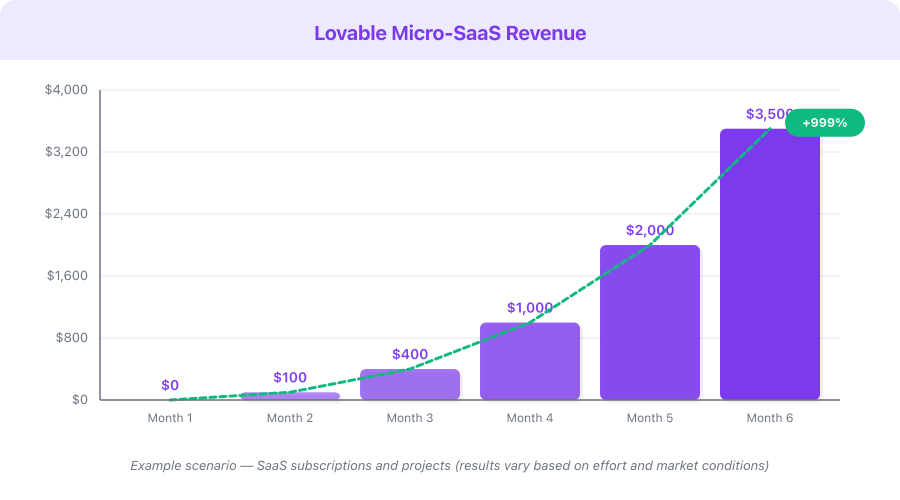
| Pre-revenue | 0 | — | $0 | $0 | Month 0 |
| Validation | 10 | $29 | $290 | $3,480 | Month 1–2 |
| Early traction | 30 | $29 | $870 | $10,440 | Month 3–4 |
| Growing | 50 | $29 | $1,450 | $17,400 | Month 4–6 |
| Established | 100 | $29 | $2,900 | $34,800 | Month 6–12 |
| Scaling | 200 | $29 | $5,800 | $69,600 | Year 2 |
| Mature | 500 | $29 | $14,500 | $174,000 | Year 2–3 |
Costs at the 100-customer stage: Lovable Pro ($50/month) + Supabase Pro ($25/month) + domain ($15/year) + Stripe fees (~3.5%) = roughly $180/month. Net profit at 100 customers: ~$2,720/month.
This is a hypothetical example based on publicly available data, not a guarantee of results. Individual results vary significantly.
Monetization Strategies
1. Subscription SaaS Revenue ($500–15,000+/month)
The primary model. Charge users a monthly subscription to access your application. Aim for $15–49/month per user depending on the value delivered. With Lovable's near-zero development costs, even 30–50 customers makes a profitable business.
2. Custom App Development Services ($1,000–10,000 per project)
Build custom web applications for businesses using Lovable. What traditional developers quote weeks for, you deliver in days. Position yourself as a "rapid application builder" — clients pay for the speed and the result, not the hours. Target small businesses, startups, and agencies that need internal tools, dashboards, or customer-facing apps.
3. Template and Starter Kit Sales ($49–299 per sale)
Build common app types (CRM, booking system, project tracker, invoice generator) as polished templates. Sell them on Gumroad or your own site. Other entrepreneurs buy your pre-built app and customize it for their niche. This is passive income — build once, sell many times.
4. MVP Development for Startups ($2,000–10,000 per project)
Help startup founders build their first version. Many founders have ideas and funding but no technical skills. You use Lovable to build their MVP in days instead of months. Charge a flat project fee, or negotiate equity/revenue share for high-potential ideas.
5. Lovable Affiliate Income ($4–10/month per referral)
Earn 20% recurring commission for 12 months on every customer you refer to Lovable. With a 60-day cookie window, mentions in blog posts, tutorials, and social media content generate ongoing referrals. 100 active referrals on the Starter plan = $400/month in passive income.
Pricing Breakdown
| Plan | Monthly Cost | What You Get | Best For |
|---|---|---|---|
| Free | $0 | 5 generations/day, 3 projects | Testing ideas, learning the platform |
| Starter | $20/mo | Unlimited generations, 10 projects | Building your first SaaS product |
| Pro | $50/mo | Unlimited everything, priority deploy | Active builders with multiple products |
| Team | $100/mo | 5 team members, custom domains | Agencies and development services |
Affiliate program: 20% recurring commission for 12 months, 60-day cookie. Payments via standard affiliate payout methods.
The ROI math: A single micro-SaaS with 50 customers at $29/month generates $1,450/month in revenue. Your Lovable Starter plan costs $20/month. That's a 72x return on your primary tool investment.
Common Mistakes
-
Building too many features before launching. The number one killer of first-time SaaS products is spending months adding features that users never asked for. Ship the MVP with one core feature. Get 10 paying users. Then ask them what to build next. Every feature you build before launch is a guess — and most guesses are wrong.
-
Not charging from day one. Offering your product for free "to get feedback" attracts users who will never pay. Free users give vague feedback like "looks nice." Paying users give specific, actionable feedback like "I need this button to also export a PDF." Charge from launch, even if the price is low.
-
Ignoring distribution entirely. A brilliant product with zero marketing gets zero customers. Spend at least as much time on distribution as you spend on building. The best micro-SaaS founders write blog posts, engage in communities, build in public, and actively pursue their first 10 customers. Building is the easy part — finding customers is the real work.
-
Trying to compete with enterprise software. Don't build "a better Notion" or "a Slack competitor." You'll lose. Instead, build "a project tracker for wedding photographers" or "a client portal for freelance accountants." Niche down until your target audience is specific enough that you can find them in one community.
-
Giving up after 10 customers. The first 10 customers are always the hardest. You're doing everything manually — marketing, sales, support, development. It feels unsustainable. But growth compounds. After 10 customers, referrals start happening. After 50, you have testimonials and case studies. After 100, the product sells itself through word-of-mouth and SEO.
-
Underestimating the value of speed. Lovable's greatest advantage is speed. You can build, launch, and test an idea in a weekend. If it doesn't work, try another one next weekend. Traditional developers spend months on a single product before learning if anyone wants it. Use your speed advantage — test 5 ideas in the time it takes a traditional developer to test 1.
-
Not owning your code. Always export your source code to GitHub. Lovable gives you full code ownership — use it. If Lovable's platform changes, your business continues. If you want to hire a developer later to add complex features, you have a codebase to build on.
Quick-Start Checklist
- Sign up for Lovable free and generate your first test app to learn the platform
- Spend 2–3 hours exploring features: generate apps, iterate with prompts, connect Supabase, test deployment
- Identify 3 micro-SaaS ideas by browsing Reddit, niche communities, and reflecting on your own pain points
- Validate your top idea by creating a Mixo landing page and driving 200+ visitors to test signup rates
- Build your MVP over a weekend — focus on one core feature, authentication, and payment integration
- Deploy to a custom domain and set up Stripe billing at $29/month
- Launch on Product Hunt, Reddit, Twitter/X, and 2–3 niche communities in the same week
- Get your first 10 paying customers and collect feedback on what to build next
- Ship one improvement per week based on user requests
- Ask every happy user for a testimonial and a referral
- Set up content marketing — write 2 blog posts per month targeting keywords your audience searches for
- Reinvest revenue into growth: better hosting, paid ads, integration development
FAQ
How technical do I need to be to build a SaaS with Lovable?
You don't need any programming knowledge. Lovable generates complete React applications from natural language descriptions. You describe what you want, and the AI builds it. That said, having a clear mental model of what your app should do — screens, user flows, data relationships — produces much better results than vague prompts. Think like a product manager, not a developer.
Can Lovable-built apps really handle paying customers?
Yes. Lovable generates production-ready React code with Supabase for the database and authentication. Apps deploy to real hosting with real URLs. Stripe integration handles subscription billing. Companies like Lumoo have scaled Lovable-built products to $800K ARR. For most micro-SaaS products serving 50–500 users, the generated code handles the load without issues.
What happens if I outgrow Lovable?
Lovable gives you full source code ownership. You can export your entire codebase to GitHub at any time. If your product grows to the point where you need custom development beyond what AI can generate, you hire a developer to work on your existing codebase. You're never locked into the platform — that's one of Lovable's strongest advantages over traditional no-code tools.
How long does it take to get my first paying customer?
Most successful micro-SaaS products get their first paying customer within 2–4 weeks of launch. The timeline depends heavily on how well you've validated the idea and how actively you pursue distribution. Founders who launch into a community where they're already active tend to get customers faster than those launching cold. Plan for 1 weekend to build, 1 week to polish and set up payments, and 2–4 weeks of active marketing to land your first 10 customers.
Is $29/month too expensive for a new SaaS product?
No — it's actually the sweet spot. At $9/month, you need 111 customers to reach $1,000/month. At $29/month, you only need 35. Lower prices also attract price-sensitive customers who churn faster and demand more support. If your tool saves someone 5+ hours per month or helps them earn more money, $29 is a no-brainer. Start at $29 and only lower the price if conversion data tells you to.
What's Next
- Read our Lovable Review for a detailed breakdown of features, pros, and cons
- Check the Lovable Pricing Guide to compare plans and find the best value
- Explore Mixo for building landing pages to validate your SaaS idea before building
- Browse Tidio for adding AI customer support to your SaaS product