How to Start a Freelance AI Content Writing Business with Writesonic in 2026
This guide contains affiliate links. If you sign up through our links, we may earn a commission at no extra cost to you. We only recommend tools we've thoroughly researched.

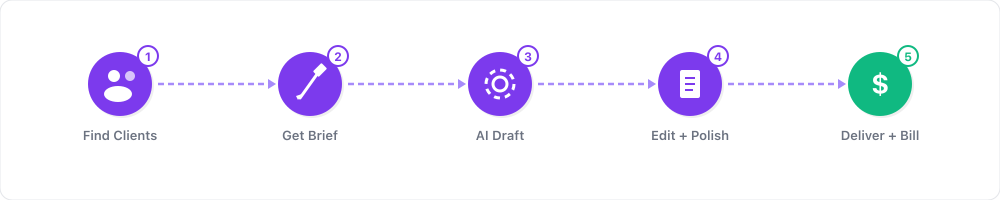
Why Freelance AI Content Writing Works in 2026
The content marketing industry is valued at over $600 billion globally, and every business with a website needs written content. Blog posts, landing pages, email sequences, product descriptions, SEO articles, whitepapers — the demand is relentless and growing.
Here is what changed: AI writing tools like Writesonic collapsed the time it takes to produce a high-quality article from 4 hours down to 45 minutes. That single shift created an entirely new business model. Freelance writers who use AI do not just write faster — they fundamentally change their unit economics. You can take on 3-5x more clients at the same quality level, or deliver the same volume while spending half the time.
This is not about replacing writing skill with automation. It is about combining your editorial judgment, subject-matter knowledge, and human voice with an AI draft engine that handles the structural heavy lifting. The writers who are thriving in 2026 are not the ones ignoring AI — they are the ones who learned to direct it.
The proof is in the results. Tasty Tours NYC used Writesonic's SEO tools to reach top 5-10 Google positions for competitive travel keywords. BlitzMetrics, a digital marketing agency, used the platform to uncover critical visibility gaps in their clients' content strategies. Individual users have reported 500% increases in search impressions after switching to AI-assisted content workflows. And across the board, content production costs have been cut in half.
If you can write a clear email, you can build a freelance AI content writing business. This guide shows you exactly how — from your first free account to a $5,000/month operation.
What You Need to Get Started
Essential Tools (Free to Start)
- Writesonic — AI writing assistant with 100+ content templates, SEO optimization, and Chatsonic (AI chat with real-time internet access). Free tier gives you 25 credits to test everything.
- Google Docs — For drafting, client collaboration, and delivering work. Free.
- Grammarly (free tier) — Grammar, spelling, and style checking as a final polish layer.
- A portfolio site — Medium, Contently, or a free WordPress blog to host your sample articles.
Upgrade When You Have Paying Clients
- Writesonic Individual Plan ($16/month) — Unlimited words, Brand Voice training, all 100+ templates, WordPress integration. One $50 blog post covers three months of the subscription.
- Hemingway Editor (free) — Readability scoring to ensure your content hits the right grade level for your audience.
- Surfer SEO ($89/month, optional) — Advanced SEO optimization that integrates directly with Writesonic for clients who demand top rankings.
Total Startup Cost
$0 to begin. $16/month once you land your first client. Under $105/month at full scale with optional SEO tooling. Compare this to the $0 revenue ceiling of doing nothing — the ROI is essentially infinite from day one.
Step 1: Choose Your Writing Niche and Define Your Offer

Generalist writers compete on price. Niche writers compete on expertise — and expertise commands premium rates. Before you write a single word for a client, decide what you are going to be known for.
High-Demand Writing Niches in 2026
| Niche | Demand Level | Typical Rate per 1,500-Word Article | AI Suitability | Why It Works |
|---|---|---|---|---|
| SaaS / Technology | Very High | $150–350 | Excellent | Every SaaS company needs blog content to drive organic signups |
| Finance / Fintech | High | $150–300 | Good (requires fact-checking) | Regulated industry means companies pay premium for accuracy |
| Health / Wellness | High | $100–250 | Good (requires YMYL care) | Massive search volume, affiliate-heavy monetization |
| Marketing / SEO | Very High | $100–250 | Excellent | Meta-niche: you write about what you do |
| E-commerce / DTC | High | $75–200 | Excellent | Product descriptions, category pages, brand storytelling |
| Real Estate | Medium | $100–200 | Good | Local SEO content, market reports, neighborhood guides |
| B2B / Enterprise | High | $200–500 | Good | Whitepapers, case studies, thought leadership |
Beginner recommendation: Start with marketing/SEO or e-commerce content. These niches have the highest demand, the lowest barriers to entry, and AI handles them exceptionally well. You can always specialize further once you have client experience.
Craft Your Offer Statement
Your offer is not "I write blog posts." Your offer is a specific result for a specific audience. Here is the formula:
"I help [type of business] [achieve specific result] through [your service]."
Examples:
- "I help SaaS startups increase organic traffic by publishing 4-8 SEO-optimized blog posts per month."
- "I help e-commerce brands convert more shoppers with product descriptions that highlight benefits, not just features."
- "I help financial advisors build authority with educational blog content that ranks on Google."
Write your offer statement down. Put it in your profiles, your outreach emails, and your proposals. Clarity converts.
Step 2: Build Your Portfolio with AI-Assisted Samples
You need 3-5 sample articles that demonstrate the quality you will deliver to paying clients. The good news: you can create these in a single afternoon using Writesonic.
How to Create Portfolio Samples That Win Clients
-
Pick 3 topics in your chosen niche. Choose topics with real search demand. Use Google's "People Also Ask" section or Writesonic's topic suggestion feature to find questions your target clients' audiences are searching for.
-
Create a content brief for each article. Before you touch Writesonic, outline what the article needs to accomplish.
Content Brief Template
Working title: [Title with primary keyword] Target keyword: [Primary keyword, e.g., "how to start freelance writing"] Secondary keywords: [3-5 related terms] Search intent: [Informational / Transactional / Navigational] Target word count: [1,500-2,500 words] Target audience: [Who is this for? Be specific.]
Outline:
- H1: [Title — include primary keyword naturally]
- Introduction (150-200 words): Hook, context, promise, preview
- H2: [Section 1 — address the "what" or background]
- H2: [Section 2 — the "how" / step-by-step]
- H2: [Section 3 — examples, case studies, or comparisons]
- H2: Common Mistakes to Avoid
- H2: Conclusion / What to Do Next
SEO checklist:
- Primary keyword in H1, first 100 words, and 1-2 H2s
- Secondary keywords used naturally throughout
- Meta title under 60 characters with primary keyword
- Meta description under 155 characters with primary keyword + benefit
- 2-4 images with descriptive alt text
Competitor reference:
- [URL 1]: What they do well / what is missing
- [URL 2]: What they do well / what is missing
Your angle / differentiator: [What will make your article better?]
-
Generate drafts with Writesonic. Use the AI Article Writer with your brief. Input your topic, target keywords, and desired tone. Writesonic produces a structured draft with headings, paragraphs, and key points in under 5 minutes.
-
Edit aggressively. This is the step that separates professionals from amateurs. Spend 30-45 minutes per article doing the following:
- Add your own insights, opinions, and analysis
- Include specific examples, data points, and case studies
- Rewrite any sections that sound generic or robotic
- Verify all facts, statistics, and claims
- Adjust the tone to match your target client's brand voice
- Add internal logic and transitions between sections
-
Publish on Medium, LinkedIn, or a free WordPress blog. These become your live portfolio pieces. Include them in every pitch and proposal.
Critical rule: Never show raw AI output as a portfolio sample. Clients can spot unedited AI content, and it signals laziness rather than efficiency. The AI generates the skeleton — you build the house.
Step 3: Set Up Your Client Acquisition Channels
You need clients to pay you. There are three channels, ranked from fastest revenue to highest revenue.
Channel 1: Freelance Platforms (First Revenue in 1-2 Weeks)
Fiverr:
- Create a gig titled: "I Will Write SEO Blog Posts for Your Business"
- Price your starter package at $50 per 1,000-word post
- Add your portfolio links to the gig description
- Deliver fast — same-day or next-day turnaround is a massive competitive advantage when AI powers your workflow
- After 5-10 five-star reviews, raise your price to $75, then $100
Upwork:
- Create a profile highlighting your niche expertise (not "I write everything")
- Apply to 5-10 relevant job posts daily with personalized proposals
- Start at $0.08-0.12/word, increase to $0.15-0.30/word as reviews accumulate
- Use the Upwork "Connects" system strategically — apply to jobs where you can demonstrate specific niche knowledge
Channel 2: Direct Outreach (Higher Rates, 2-4 Week Ramp)
Direct outreach puts you in front of businesses that need content but have not posted a job listing. This is where the premium clients live.
The pitch process:
- Find businesses in your niche that have active blogs (they already value content)
- Identify posts that are outdated, thin, or poorly optimized
- Send a personalized pitch email
Freelance Writer Pitch Email Template
Subject: [Company Name] content idea: [Article topic in 5-7 words]
Hi [First Name],
I am [Your Name], a freelance content writer specializing in [your niche]. I have written for [1-2 notable clients or publications, or "businesses like X and Y in the [industry] space"].
I came across [Company Name]'s blog and noticed your article on [specific topic] could be updated with [specific improvement — new data, expanded sections, better SEO targeting]. I have a few content ideas that could drive more organic traffic to your site:
- "[Proposed title 1]" — targeting [keyword] with [X monthly searches]
- "[Proposed title 2]" — addressing [gap in their current coverage]
I would be happy to write a trial article at a reduced rate so you can evaluate my work with zero risk. My typical turnaround is 2-3 business days for a 1,500-word SEO article.
Portfolio: [link]
Worth a quick chat this week?
[Your Name]
- Send 5-10 pitches per day. At a 5-10% response rate, you will have conversations within a week.
- Offer a trial article at a slight discount — $60-75 instead of your standard $100-150 — to convert the first project into a retainer.
Channel 3: Content Agencies and Networks (Steady Volume)
Agencies like Verblio, nDash, and ClearVoice connect writers with businesses. Pay ranges from $0.06-0.15/word, with volume making up for lower per-piece rates. These are excellent for filling gaps between direct clients and building a consistent income floor.
Step 4: Deliver Professional Work with a Repeatable System
Once you land clients, speed and consistency determine whether they stay. Here is the production workflow that turns Writesonic into a reliable content engine.
The 45-Minute Article Workflow
| Phase | Time | What You Do |
|---|---|---|
| Receive and review the brief | 5 min | Confirm topic, keywords, word count, tone, and any client-specific requirements |
| Research with Chatsonic | 10 min | Use Chatsonic's real-time internet access to gather current statistics, quotes, and competitive insights |
| Generate draft with Article Writer | 5 min | Input your brief, keywords, and tone. Generate the full structured draft |
| Edit, enhance, and humanize | 20-25 min | Add personal insights, specific examples, improve flow, fact-check every claim, adjust tone to client's Brand Voice |
| SEO and readability optimization | 5 min | Check keyword placement, meta description, heading structure, readability score |
| Final proofread and delivery | 5 min | Run through Grammarly, format in Google Docs, submit to client |
Total time per 1,500-word article: 45-60 minutes.
Compare this to 3-4 hours without AI. At $100 per article, your effective hourly rate lands between $100-130/hour. At $200 per article for specialized B2B content, you are earning $200-260/hour of actual work time.
Using Brand Voice for Client Consistency
One of Writesonic's most valuable features for freelancers is Brand Voice. Upload 3-5 samples of your client's existing content, and Writesonic trains itself on their tone, vocabulary, and style. Every draft it generates will match their brand — which means less editing time for you and happier clients who feel like you "get" their voice.
Set up a separate Brand Voice profile for each client. The 5 minutes this takes upfront saves you 10-15 minutes of tone adjustment on every article.
Step 5: Scale from Side Hustle to Full Business
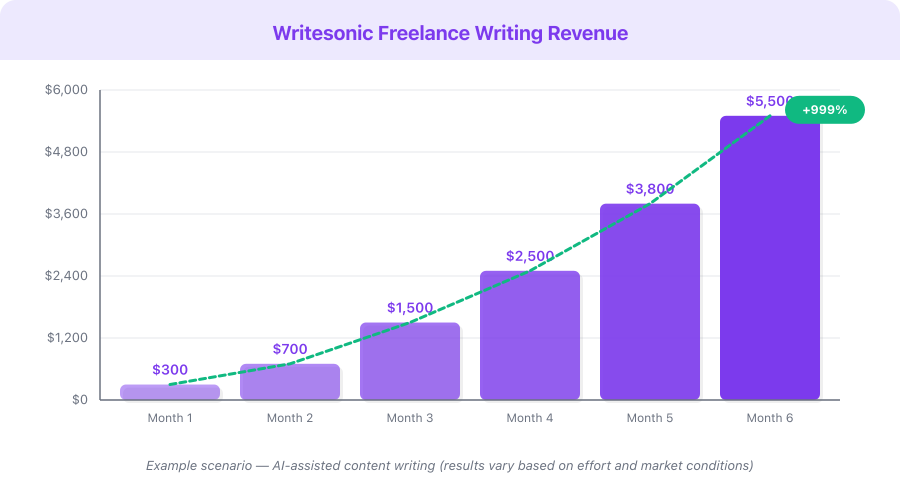
Revenue Growth Roadmap
Example Scenario: These projections illustrate potential growth trajectories based on industry averages. Individual results will vary based on niche, effort, skill level, and market conditions.
| Timeline | Clients | Articles/Month | Avg Rate per Article | Monthly Revenue | Key Focus |
|---|---|---|---|---|---|
| Month 1 | 1-2 | 4-8 | $50-75 | $200-600 | Build portfolio, get first reviews |
| Month 2-3 | 3-5 | 12-20 | $75-100 | $900-2,000 | Raise rates, add Upwork/direct clients |
| Month 4-6 | 5-8 | 20-32 | $100-150 | $2,000-4,800 | Convert one-offs to retainers |
| Month 7-12 | 5-10 | 20-40 | $125-200 | $2,500-8,000 | Specialize deeper, add premium services |
| Year 2 | 8-15 | 30-60 | $150-300 | $4,500-18,000 | Hire subcontractors, build agency |
Five Strategies for Hitting $5,000/Month
-
Convert projects to retainers. A client paying $100/article for 4 articles/month is worth $400/month of predictable revenue. Five retainer clients at this level puts you at $2,000/month with minimal client acquisition effort.
-
Raise rates every 10 completed projects. Your first articles should be priced to win — $50-75 each. After 10 deliveries with positive feedback, raise to $100. After 20, raise to $125-150. The clients who value quality will stay. The ones who leave were not your ideal clients anyway.
-
Stack premium services on top of writing. Once you understand a client's content needs, offer adjacent services: content strategy ($500-1,500/month), SEO audits ($200-500 per audit), content calendar planning ($300-500/quarter), or WordPress publishing management ($100-200/month add-on).
-
Specialize into a lucrative sub-niche. "I write SaaS content" commands lower rates than "I write product-led growth content for B2B SaaS companies in the $1M-10M ARR range." The narrower your positioning, the higher your perceived expertise and the more you can charge.
-
Build a team. Once you are consistently earning $3,000-5,000/month solo, hire 1-2 junior writers. Train them on your Writesonic workflow, pay them $30-50 per article, and charge clients $100-200. Your margin is $50-150 per article on work you did not write. This is how freelancers become agencies.
Step 6: Land Premium Clients with Content Strategy Proposals
The highest-paying freelance writing clients do not want individual articles — they want a content partner who thinks strategically. Once you have 3-6 months of experience, start pitching content strategy packages instead of per-article pricing.
What a Content Strategy Package Looks Like
Bronze Package — $800-1,200/month:
- 4 SEO-optimized blog posts (1,500 words each)
- Keyword research and content brief creation
- WordPress publishing (if applicable)
- Monthly performance report
Silver Package — $1,500-2,500/month:
- 8 SEO-optimized blog posts
- Content calendar planning
- On-page SEO optimization
- Email newsletter writing (4 per month)
- Monthly strategy call
Gold Package — $3,000-5,000/month:
- 12+ blog posts
- Full content strategy and editorial calendar
- SEO audits and competitor analysis
- Email sequences and lead magnet copy
- Social media content repurposing
- Bi-weekly strategy calls
At the Gold level, you need just 1-2 clients to generate a full-time income. Writesonic's speed makes it possible to deliver this volume as a solo operator.
Real-World Examples and Case Studies
Case Study 1: Tasty Tours NYC — From Invisible to Top 10 Rankings
Tasty Tours NYC, a food tour company, used Writesonic's SEO content tools to create location-specific blog content targeting competitive travel keywords. Within months, they reached top 5-10 Google positions for their target search terms. The key was not just generating content with AI — it was combining Writesonic's draft speed with genuine local expertise that no competitor could replicate.
Takeaway for freelancers: When you pitch local businesses, this is the case study that sells. You can offer the same result — AI speed plus your editorial quality — at a fraction of what an SEO agency charges.
Case Study 2: BlitzMetrics — Uncovering Visibility Gaps at Scale
BlitzMetrics, a digital marketing education company, used Writesonic to analyze and fill content gaps across their web properties. The platform's SEO tools identified critical visibility opportunities that manual auditing had missed. By systematically creating content to fill these gaps, they improved their organic search presence significantly.
Takeaway for freelancers: Offer "content gap analysis" as a paid service ($200-500). Use Writesonic's SEO features to find what your client is missing, then propose articles to fill those gaps. You just created your own pipeline of work.
Case Study 3: The 500% Impressions Increase
An independent content creator switched from manual writing to a Writesonic-powered workflow and reported a 500% increase in search impressions. The improvement came not just from writing more — it came from writing more strategically. Writesonic's keyword targeting and SEO optimization tools ensured every article was built to rank, not just built to exist.
Case Study 4: Cutting Content Costs in Half
Multiple users have reported cutting their content production costs by 50% after adopting Writesonic. For freelancers, this cuts both ways: your own overhead drops (you produce faster), and you can undercut agency pricing while maintaining healthy margins. A $150 article that takes you 45 minutes represents a $200/hour effective rate — competitive with senior consultants.
Monetization Strategies: 5 Ways to Earn with AI Writing
1. Freelance Blog Writing (Fastest Path to Revenue)
Offer SEO blog writing services on Fiverr, Upwork, and through direct outreach. Use Writesonic to generate drafts 3-5x faster than manual writing, then edit and polish to client standards. Earn $50-300 per article depending on niche and complexity.
2. SEO Content Retainers (Most Predictable Income)
Package monthly content plans — 4-12 articles per month with keyword research, writing, and basic SEO optimization. Charge $500-3,000/month per client. Retainers create predictable revenue and reduce the time you spend on client acquisition.
3. E-Commerce Product Descriptions (Highest Volume)
Shopify stores, Amazon sellers, and DTC brands need hundreds of product descriptions. Writesonic's product description templates can generate 50-100 descriptions per day with your editing. Charge $5-20 per description or $500-2,000 per bulk project.
4. Email Marketing Copy (Recurring Work)
Write email sequences, newsletters, and promotional campaigns for businesses. Use Writesonic's email templates for rapid drafting. Charge $100-500 per email sequence or $500-1,500/month for ongoing email content management.
5. Build and Sell Niche Content Sites (Long-Term Passive Income)
Create SEO-optimized blogs in profitable affiliate niches — personal finance, health, tech reviews, pet care. Use Writesonic to produce 3-5 articles per week. Monetize with affiliate links and display ads. A well-built niche site can generate $500-5,000/month passively after 6-12 months of content building. Some operators sell these sites for 30-40x monthly revenue.
Pricing Breakdown and ROI Analysis
Your Investment
| Tool | Monthly Cost | What You Get |
|---|---|---|
| Writesonic Free | $0 | 25 credits — enough to test and create portfolio samples |
| Writesonic Individual | $16/month ($13/month annual) | Unlimited words, Brand Voice, all templates, WordPress integration |
| Writesonic Team | $33/month ($26/month annual) | Multi-user, API access — for when you hire writers |
| Grammarly Free | $0 | Grammar and style checking |
| Google Docs | $0 | Writing and collaboration |
| Total (solo freelancer) | $16/month | Everything you need to earn $2,000-5,000+/month |
ROI by Activity
Example Scenario: Individual results vary based on niche, skill, and client acquisition ability.
| Activity | Monthly Cost | Monthly Revenue | Monthly Profit | ROI |
|---|---|---|---|---|
| 5 blog posts at $100 each | $16 | $500 | $484 | 31x |
| 10 blog posts at $150 each | $16 | $1,500 | $1,484 | 93x |
| 2 content retainers at $1,000 each | $16 | $2,000 | $1,984 | 124x |
| 1 Gold content strategy package | $16 | $3,000-5,000 | $2,984-4,984 | 186-311x |
At $16/month, Writesonic delivers the highest ROI of any tool investment a freelance writer can make. A single $50 blog post covers the subscription for over three months.
Common Mistakes to Avoid
1. Publishing Raw AI Output
This is the fastest way to lose a client and damage your reputation. AI-generated content without human editing reads generic, lacks nuance, and can contain factual errors. Google's Helpful Content guidelines specifically target low-quality, AI-generated content that does not add value. Always edit, fact-check, and inject your expertise.
2. Competing on Price Instead of Value
When you price at $15 per article, you attract clients who do not value writing. These clients complain the most, pay the slowest, and leave the worst reviews. Price based on the value you deliver — SEO rankings, organic traffic, lead generation — not the number of words you type.
3. Taking on Every Client Who Asks
Saying yes to projects outside your niche, below your rate, or with unreasonable deadlines leads to burnout and mediocre work. It is better to have 3 great clients at premium rates than 10 difficult clients at bargain rates.
4. Skipping the Content Brief
Writing an article without a content brief is like building a house without blueprints. You waste time on revisions, produce unfocused content, and frustrate clients. Always start with a brief — even a simple one — and get client approval before writing.
5. Ignoring SEO Fundamentals
Beautiful prose that nobody finds on Google earns nothing for your client. Every article should target a specific keyword, include proper heading structure, and follow on-page SEO basics. Writesonic's built-in SEO tools make this easier, but you still need to understand the fundamentals.
6. Not Building Systems
Top-earning freelancers have systems for everything: client onboarding, content brief templates, invoicing schedules, and follow-up sequences. Build these from day one. The freelancers earning $5,000+/month spend less time on admin because their systems handle it.
7. Neglecting Existing Client Relationships
Acquiring a new client costs 5-10x more effort than keeping an existing one. Check in with clients monthly, proactively suggest content ideas, and deliver above expectations. A client who trusts you will increase their budget before they will shop for a replacement.
Quick-Start Checklist
Use this checklist to go from zero to first client as fast as possible:
- Sign up for Writesonic free and explore the Article Writer, templates, and Chatsonic
- Choose your writing niche (pick ONE to start — you can expand later)
- Write your offer statement: "I help [who] [achieve what] through [your service]"
- Create a content brief for 3 portfolio articles using the template above
- Generate drafts with Writesonic and edit each one for 30-45 minutes
- Publish portfolio articles on Medium, LinkedIn, or a free WordPress blog
- Create a Fiverr gig and/or Upwork profile optimized for your niche
- Send 5 direct outreach pitches using the pitch email template
- Apply to 5-10 relevant jobs on freelance platforms
- Deliver your first article within 24 hours of receiving the brief
- Ask every satisfied client for a testimonial and a referral
- Upgrade to Writesonic Individual ($16/month) once you have paying work
Frequently Asked Questions
Will clients know I am using AI?
Only if you deliver unedited AI output. When you use Writesonic to generate a first draft and then spend 20-30 minutes adding your expertise, examples, and editorial polish, the result is indistinguishable from a fully manual article — and often better, because the AI ensures comprehensive structure. What clients care about is quality, accuracy, and whether the content ranks. They do not care about your process.
How much can I realistically earn in my first month?
Most freelancers who follow this system earn $200-600 in their first month by landing 1-2 clients through platforms or outreach. The limiting factor is not the writing — it is client acquisition. If you apply to 5 jobs per day and send 5 outreach emails per day, you will have paying work within 2 weeks.
Do I need writing experience to start?
Formal writing experience helps but is not required. If you can write a clear, grammatical email, you have the baseline skill. Writesonic handles structure, research assistance, and initial drafting. Your job is editorial judgment: making the content specific, accurate, and valuable for the reader. Start with simpler content types (listicles, how-to guides) and work your way up to more complex formats (whitepapers, case studies).
Is the market for freelance writing saturated?
The market for cheap, generic writing is saturated. The market for niche-specific, SEO-optimized, strategically written content is wide open. Businesses are drowning in AI-generated fluff and are actively looking for writers who can combine AI efficiency with genuine expertise. That is your positioning.
What happens when AI gets even better — will it replace freelance writers?
AI will continue to improve at generating raw text. It will not improve at understanding a client's business context, interviewing subject-matter experts, providing strategic content direction, or building trust-based client relationships. The writers who survive and thrive are those who position themselves as content strategists and editors, not typists. Writesonic accelerates your work; it does not replace your judgment.
What's Next
You have the tools, the templates, and the strategy. The only variable left is execution.
Start with the smallest possible action: sign up for Writesonic, write one portfolio article today, and send one pitch email tomorrow. Within two weeks, you will have your first paying client. Within three months, you can realistically hit $1,000-2,000/month. Within a year, $5,000/month is achievable for anyone who treats this like a real business.
The demand for quality content is not slowing down. AI made the supply side faster. The writers who combine AI speed with human quality are building the most profitable freelance writing businesses in history.
Your first $50 article is waiting. Go get it.