How to Start a Print-on-Demand Business with Kittl in 2026
This guide contains affiliate links. If you sign up through our links, we may earn a commission at no extra cost to you. We only recommend tools we've thoroughly researched.
Why Print-on-Demand with Kittl Works in 2026
Print-on-demand has evolved from a side-hustle experiment into a legitimate business model, and the numbers confirm it. The global print-on-demand market is projected to reach $45.6 billion by 2031, growing at over 24% annually. Platforms like Redbubble, Printful, and Merch by Amazon handle millions of orders per month. The barrier to entry has never been lower, and the market is still growing faster than it is saturating.
Kittl has positioned itself at the center of this opportunity. The platform has crossed 10 million users and generated $17.5 million in revenue by building a design tool purpose-built for merchandise. Unlike general-purpose AI image generators that produce complex, photographic images poorly suited for products, Kittl specializes in exactly the design types that sell on merchandise: bold typography, clean graphic layouts, vintage illustrations, and scalable vector art.
The economics of print-on-demand are uniquely compelling. You create a design once and upload it to one or more POD platforms. When a customer orders, the platform prints your design on the product, ships it directly to the buyer, and pays you a royalty. You never touch inventory, never handle shipping, never deal with returns, and never invest in manufacturing. Your only costs are your time and your Kittl subscription — which starts at $10/month for full commercial use.
Traditional merchandise businesses require thousands in upfront inventory investment, warehouse space, shipping logistics, and the risk of unsold stock. POD eliminates all of that. If a design does not sell, you lose nothing. If it goes viral, the platform handles fulfillment at any scale. This asymmetric risk-reward profile is why POD attracts hundreds of thousands of new sellers every year.
Kittl's specific advantages over other design tools for POD are significant. Its typography engine rivals Adobe Illustrator — text warping, path text, professional kerning, and typographic effects that AI image generators simply cannot produce. Typography-heavy designs (quotes, slogans, wordplay, brand names) are consistently the best sellers in print-on-demand because they are personal, relatable, and giftable. Kittl also exports in vector format, meaning your design scales perfectly from a phone case to a wall poster without losing quality. And its one-click mockup generator shows your design on real products instantly, giving you ready-to-use listing images.
The competitive advantage for Kittl users is timing and tool quality. Most POD sellers still use Canva, basic free tools, or struggle with professional software like Illustrator. Kittl gives you Illustrator-quality typography with Canva-level ease of use, plus AI generation specifically trained on merchandise-style designs. That combination produces designs that look more professional than the majority of what is currently listed on POD platforms.
What You Need to Get Started
Setting up your POD business correctly from day one prevents the disorganization, wasted time, and inconsistent quality that kills most new sellers within their first 3 months.
Accounts needed (all free or low-cost):
- Kittl account — free to test, Pro at $10/month for full commercial license and print-quality exports
- Redbubble account — completely free, instant access, built-in marketplace traffic
- Etsy seller account — $0.20 per listing fee, no monthly subscription
- Merch by Amazon — free, requires application (apply early, approval takes 2–12 weeks)
- Printful or Printify account — free to create, they produce and ship when orders come in
Hardware:
- Any computer with a modern web browser — Kittl runs entirely in the cloud
- Reliable internet connection
- 10–20 GB of storage for design files and exports
Skills needed:
- Basic visual design sense (what looks good on a t-shirt vs. what looks cluttered)
- Niche research ability (understanding what specific audiences want to wear and display)
- Keyword research for POD platform optimization
- Patience — POD is a volume game that rewards consistency over months, not days
Optional but valuable:
- Familiarity with Etsy SEO (eRank or Marmalead for keyword research)
- A Pinterest business account for driving traffic
- Merch Informer or similar tool for Amazon Merch keyword and competition analysis
- Basic understanding of color theory for merchandise (which colors print well, contrast rules)
Step 1: Choose Your Niche Strategically

The single biggest factor in POD success is niche selection. A focused niche with passionate buyers outperforms broad, generic designs by 10x or more. Passionate niche audiences buy for identity expression — the shirt, mug, or poster tells the world something about who they are. That emotional connection drives impulse purchases, gift buying, and repeat orders.
Highest-performing POD niches in 2026:
| Niche Category | Example Sub-Niches | Design Style | Buyer Motivation | Gift Potential |
|---|---|---|---|---|
| Dog breeds | Golden Retriever, French Bulldog, Dachshund | Cute illustrations, funny quotes | Identity, love for breed | Very high |
| Professions | Nurse, teacher, engineer, accountant, firefighter | Typography, humor, pride | Professional identity | Very high |
| Hobbies | Fishing, hiking, gardening, gaming, woodworking | Vintage graphics, slogans | Enthusiast pride | High |
| Parenting | New dad, boy mom, twin parent, grandparent | Humor, sentiment | Identity, humor | Very high |
| Fitness | Gym humor, running, yoga, CrossFit, weightlifting | Bold typography, motivation | Gym culture | Medium |
| Astrology | Each zodiac sign (12 separate sub-niches) | Celestial imagery, personality traits | Personal identity | Very high |
| Occupational humor | IT, accounting, retail, healthcare, teaching | Sarcasm, insider jokes | Insider humor | High |
| Local and travel | State pride, city names, national parks | Vintage, retro, geographic | Place attachment | High |
| Seasonal events | Christmas, Halloween, Thanksgiving, July 4th | Holiday themes, seasonal humor | Celebration | Very high |
| Pop culture themes | Retro aesthetics, meme culture, internet humor | Trendy, current | Social relevance | Medium |
Niche selection criteria:
- Passionate audience — Do people in this niche already buy merchandise? Check Redbubble and Etsy to confirm.
- Gift market potential — Can someone buy this as a gift? "Funny Nurse Shirt" works as both a self-purchase and a gift. This effectively doubles your buyer pool.
- Keyword volume — Are people searching for products in this niche? Use Etsy autocomplete and Merch Informer to verify.
- Design feasibility — Can you create compelling designs in this niche with Kittl? Typography and slogan-based niches work best with Kittl's strengths.
- Evergreen vs. trending — Evergreen niches (dog breeds, professions) generate consistent year-round sales. Trending niches (memes, current events) can spike but fade quickly. Start with evergreen.
Start with 2–3 niches and create 10–15 designs per niche. After 30–60 days, your sales data will tell you which niche to go deep on. Do not commit entirely to one niche before testing.
Step 2: Research What Actually Sells Before Designing
Designing without research is the most common mistake new POD sellers make. Spending 30 minutes on research before each design session saves hours of wasted effort on designs nobody wants.
Research process:
-
Search your niche on Redbubble, Etsy, and Amazon. Sort by best-selling or most popular. Study the top 20 results. What do the designs have in common? What styles, colors, and phrases appear repeatedly?
-
Identify design patterns that sell. In most niches, the top sellers follow predictable patterns:
- Typography-heavy designs with 1–3 lines of text (quotes, slogans, one-liners)
- Clean, simple graphics with 1–3 colors that print well
- Niche-specific humor that makes the buyer feel seen and understood
- Vintage and retro aesthetics (distressed textures, serif fonts, muted colors)
- Minimal designs with strong visual impact at thumbnail size
-
Find gaps in the market. What is missing? Are there sub-niches nobody is serving? Are the existing designs outdated or low quality? Can you improve on the best-sellers with better typography, cleaner layouts, or funnier copy?
-
Save reference images. Create a folder for each niche with screenshots of top-selling designs. This is not for copying — it is for understanding the visual language that resonates with buyers in that niche.
What to avoid designing:
- Complex photographic images — they do not print well on most merchandise
- Designs with more than 4 colors — multi-color printing costs more, reducing your margin
- Text too small to read at thumbnail size — if buyers cannot read it in search results, they will not click
- Anything requiring a license (trademarked phrases, copyrighted characters, celebrity likenesses)
- Generic motivational quotes without a niche angle — "Live Laugh Love" has millions of competitors
Step 3: Design in Kittl for Maximum POD Quality
Open Kittl and build your designs using Kittl's specific strengths. Here is the workflow that produces consistently sellable output.
Design workflow:
-
Set up your canvas. Use the product-specific dimensions for your target platform. Kittl includes presets for common POD product sizes. For t-shirts, start with 4500x5400 pixels (Redbubble standard). For mugs, use 4600x1900 pixels.
-
Start with typography. Kittl's text tools are its biggest differentiator. Type your slogan or quote, then experiment with font pairings, text warping, path text, and typographic effects. A well-designed typographic layout is the foundation of most best-selling POD designs.
-
Apply Kittl's AI generation for graphic elements. Describe the illustration or graphic element you need — "vintage fishing illustration" or "retro mountain badge" — and Kittl generates options designed specifically for merchandise. These AI-generated elements are immediately usable, unlike outputs from general-purpose AI image generators that need heavy editing.
-
Layer and compose. Combine your typography with graphic elements, borders, textures, and effects. Kittl's layering system works like Illustrator but with a much gentler learning curve.
-
Preview on mockups. Use Kittl's one-click mockup generator to see your design on real products. Check how it looks on t-shirts (front and back), hoodies, mugs, posters, and tote bags. If the design does not look good on a product, adjust before exporting.
-
Export for each platform. Kittl includes POD-specific export presets that match the exact specifications for Redbubble, Printful, Printify, and Merch by Amazon. Use them to avoid rejection for incorrect dimensions or file formats.
Design rules for best-selling POD products:
- 1–3 colors maximum for t-shirts. Fewer colors = lower print cost = higher margin. Plus, simple designs are more visually striking on merchandise.
- Readable at thumbnail size. If buyers cannot read your text in a 200px-wide search result thumbnail, your listing will not get clicks.
- Test on both light and dark backgrounds. Create a light version and a dark version of each design. Some platforms automatically apply designs to multiple shirt colors.
- Create variations. For every design, create 3–5 variations: different color schemes, alternate word choices, related slogans for the same niche. One concept generates 3–5 separate listings.
- Use transparent backgrounds. Always export with a transparent background so the design sits cleanly on any product color.
Print-on-Demand Product Description Template:
TITLE (keyword-rich, platform-specific format): [Primary Keyword] — [Design Description] | [Niche] [Product Type] | [Occasion/Gift Keyword] | [Audience]
Example: "Funny Nurse Shirt — Trust Me I'm Almost a Nurse | Nursing Student Gift | RN Graduation | Healthcare Humor T-Shirt"
DESCRIPTION: The perfect [product type] for [audience]. This [style] design features [design description] — ideal for [occasion 1], [occasion 2], or just showing off your [niche] pride.
Makes an amazing gift for:
- [Gift recipient 1] (e.g., nursing school graduates)
- [Gift recipient 2] (e.g., your favorite healthcare worker)
- [Gift recipient 3] (e.g., anyone who appreciates medical humor)
- [Occasion] (e.g., Nurses Week, graduation, birthday)
Available on multiple product types — check the dropdown for t-shirts, hoodies, mugs, stickers, posters, and more.
TAGS: [niche] shirt, [audience] gift, funny [niche], [specific keyword], [profession/hobby] humor, [occasion] gift, [niche] tee, [product type] [niche], [related keyword], [seasonal keyword]
Etsy POD Listing Template:
TITLE (140 chars, keyword-loaded): [Design Text/Theme] Shirt | [Niche] T-Shirt | [Audience] Gift | [Occasion] | Funny [Niche] Tee | [Product Variant]
DESCRIPTION: Looking for the perfect [product type] for the [niche enthusiast/professional] in your life? This [style] design says it all — [design text or description].
Product details:
- Premium quality [product type] (printed and shipped by [POD platform])
- Available in sizes [S–5XL] and multiple colors
- Machine washable, pre-shrunk, comfortable fit
- Printed with eco-friendly, durable inks
Also available on:
- Hoodies and sweatshirts
- Mugs (11oz and 15oz)
- Stickers (various sizes)
- Posters and wall art
- Tote bags and accessories
Perfect for:
- [Occasion 1] gifts
- [Occasion 2] celebrations
- Everyday wear for proud [niche members]
- Stocking stuffers and birthday surprises
Shipping: Printed on demand and shipped directly to you within [3–7] business days.
TAGS: [niche] shirt, funny [niche] tee, [audience] gift, [occasion] present, [specific keyword], [niche] humor, [profession] t-shirt, [hobby] gear, [related niche], custom [niche] tee, [seasonal keyword], [gift keyword], [niche] lover
Step 4: Choose and Set Up Your POD Platforms
Each POD platform has different strengths, audiences, and economics. Starting with the right platform combination accelerates your path to profitability.
| Platform | Setup Cost | Royalty/Profit | Product Range | Built-in Traffic | Best For |
|---|---|---|---|---|---|
| Redbubble | $0 | $2–8/sale | 70+ products | High (marketplace) | Beginners, testing designs |
| Merch by Amazon | $0 | $3–12/sale | T-shirts, hoodies, popsockets | Very high (Amazon traffic) | Highest volume potential |
| Printful + Etsy | $0.20/listing | You set margin ($5–15) | 300+ products | High (Etsy search) | Brand building, premium pricing |
| Printify + Shopify | $39/mo (Shopify) | You set margin ($5–20) | 800+ products | None (you drive traffic) | Full brand control, highest margins |
| Teepublic | $0 | $4–7/sale | 20+ products | Medium | Graphic-heavy niche designs |
Recommended starting strategy:
- Week 1: Upload your first 15–20 designs to Redbubble (free, instant access, zero risk)
- Week 1: Apply for Merch by Amazon (takes 2–12 weeks for approval — apply early)
- Month 2: Once you identify your best-selling designs, create Printful + Etsy listings for those winners (Etsy's audience + custom pricing)
- Month 3–6: Consider Shopify + Printify for full brand control once you have proven designs and want to build a standalone brand
Platform-specific tips:
- Redbubble: Enable every product type for each design — a single upload can appear on 70+ products. Write keyword-rich tags (Redbubble allows up to 15). Price your products at the default margin to start, increase by 10–20% once you have sales.
- Merch by Amazon: Start in Tier 10 (10 design slots). Your priority is selling 10 units to reach Tier 25, then 25 to reach Tier 100. Focus on niches with high search volume and moderate competition. Amazon's traffic volume is unmatched.
- Etsy via Printful: Set your own retail price (cost + your margin). Typical margin: $8–15 per t-shirt. Use Printful's mockup generator for listing images. Optimize listings with Etsy SEO best practices.
Step 5: Scale Your POD Business Systematically
POD is fundamentally a volume and iteration game. The sellers earning $2,000–10,000/month have hundreds of designs across multiple platforms and niches. Here is how to build that volume efficiently.
Daily production workflow (60–90 minutes):
- 30 minutes: Research trending topics and niche-specific content in your niche communities, Reddit, Instagram, and Pinterest
- 30–45 minutes: Create 3–5 new designs in Kittl using variations of proven formats
- 15 minutes: Export, upload to platforms, optimize listings with keywords
Scaling framework:
| Phase | Designs | Expected Monthly Revenue | Focus |
|---|---|---|---|
| Testing (Month 1–2) | 30–60 | $50–200 | Test 2–3 niches, identify what sells |
| Building (Month 3–4) | 100–200 | $200–800 | Go deep on winning niche, expand to 2 platforms |
| Growing (Month 5–8) | 200–500 | $800–3,000 | Add new sub-niches, seasonal designs, Amazon Merch |
| Scaling (Month 9–12) | 500–1,000 | $2,000–8,000 | Multiple platforms, brand building, Etsy shop |
| Mature (Year 2+) | 1,000+ | $5,000–20,000+ | Full brand, Shopify store, new niche verticals |
Key scaling strategies:
-
Double down on winners. When a design sells, create 5–10 variations immediately: different color schemes, alternate phrasing, related slogans for the same audience. One winning concept can generate 10 separate listings.
-
Seasonal design calendar. Create seasonal products 8–10 weeks before the event. The biggest sales windows: Christmas (design in September), Halloween (design in July), Valentine's Day (design in December), Father's/Mother's Day (design in March), Back to School (design in June).
-
Cross-platform your best sellers. A design that sells on Redbubble will likely sell on Etsy, Amazon, and Teepublic too. Upload your top 20% of designs to every platform you are on.
-
Expand niches strategically. Once your first niche has 100+ designs, replicate the entire process for a related niche. If "nurse humor" works, try "doctor humor," "paramedic humor," and "pharmacist humor." Each adjacent niche is faster to enter because you understand the formula.
-
Build an Etsy brand. While Redbubble and Amazon offer traffic, Etsy allows you to build a branded shop with repeat customers. Create a cohesive shop around your best niche, offer bundle deals, and build a following.
Step 6: Offer Custom Merchandise Design Services
Once you have a portfolio of POD designs and sales data, you can offer custom merchandise design as a premium service. This generates much higher revenue per hour than passive POD sales.
Service opportunities:
- Event merchandise — Custom shirts, mugs, and accessories for corporate events, team building, family reunions, bachelor/bachelorette parties, and community fundraisers. Charge $50–150 per design.
- Small business merchandise — Branded t-shirts, tote bags, and promotional items for local businesses, restaurants, breweries, and gyms. Charge $100–300 per design set.
- Niche brand creation — Help entrepreneurs build themed merchandise brands from scratch. Design the initial collection, set up their POD platform, and consult on niche selection and SEO. Charge $300–800 for a full brand setup package.
List these services on Fiverr (start at $25–50 to build reviews, then raise to $75–200), Upwork (target small businesses), and your own website. Your Redbubble and Etsy shops serve as your portfolio.
Real-World Examples and Case Studies
Claudia Spiller Reed — Apparel Brand Built with Kittl: Claudia Spiller Reed used Kittl to build her apparel brand, leveraging the platform's typography tools and AI design generation to create merchandise that resonated with her target audience. Her story is featured on Kittl's website as an example of how creators use the platform to build real product businesses from scratch. The combination of professional-quality design tools at an accessible price point enabled her to compete with established apparel brands. Source: kittl.com
Kittl Platform Growth: Kittl has grown to over 10 million users and generated $17.5 million in revenue. The platform's rapid growth reflects the demand for design tools specifically built for merchandise and print-on-demand. Unlike general-purpose design platforms, Kittl's focus on POD-specific features — vector output, typography tools, AI merchandise design generation, and platform-specific export presets — gives its users a measurable quality advantage.
POD Industry Data: Print-on-demand sellers on Etsy and Redbubble report average royalties of $3–10 per sale depending on the product type and platform. Sellers with 200+ designs typically see 100–500 sales per month. Top POD sellers with 1,000+ designs across multiple platforms report $5,000–20,000+ in monthly revenue. The key differentiator is design volume combined with niche focus and keyword optimization.
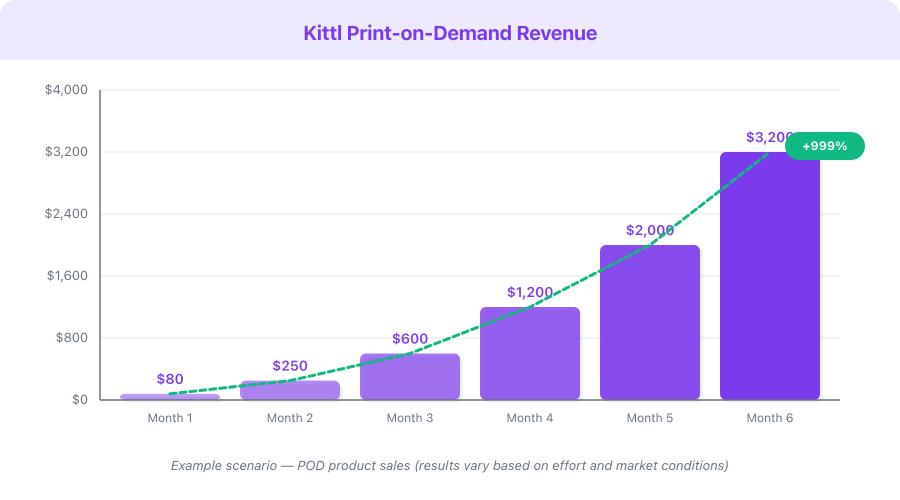
Revenue Projection — Building a POD Business with Kittl:
| Month | Active Designs | Platforms | Monthly Sales | Avg Royalty | Monthly Revenue |
|---|---|---|---|---|---|
| 1–2 | 30–60 | 1 (Redbubble) | 10–30 | $4 | $40–120 |
| 3–4 | 80–150 | 2 | 30–80 | $5 | $150–400 |
| 5–8 | 200–400 | 3 | 80–250 | $6 | $480–1,500 |
| 9–12 | 400–800 | 3–4 | 250–700 | $6 | $1,500–4,200 |
| Year 2 | 800–1,500 | 4+ | 700–2,500 | $7 | $4,900–17,500 |
This is a hypothetical example based on publicly available data, not a guarantee of results. Individual results vary significantly.
Monetization Strategies
1. Passive POD Royalties — $500–5,000/month
Upload designs to Redbubble, Merch by Amazon, Teepublic, and other marketplace platforms. Earn royalties on every sale without any fulfillment work. Revenue scales with design volume across platforms. Aim for 500+ designs across 2–3 platforms within your first year.
Dollar range: $2–12 per sale depending on product type and platform. Target $500–5,000/month with 300–1,000 active designs.
2. Etsy POD Shop — $500–5,000/month
Connect Printful or Printify to an Etsy shop and set your own retail prices. You control the margin, the branding, and the customer experience. Higher per-sale profit than marketplace platforms, plus the ability to build a brand with repeat customers.
Dollar range: $5–15 profit per sale (you set the price). Target $500–5,000/month with 100–300 optimized listings and Etsy SEO.
3. Custom Merchandise Design Services — $500–3,000/month
Offer done-for-you merchandise design for businesses, events, and entrepreneurs. Use your Kittl skills and POD knowledge to create designs and set up their sales infrastructure. Higher revenue per hour than passive sales.
Dollar range: $50–300 per project. 5–15 clients per month generates $500–3,000.
4. Design Template Sales — $200–1,500/month
Create editable Kittl design templates and sell them on Etsy, Gumroad, or Creative Market. Other POD sellers buy templates to customize for their own products. This turns your design skills into a product that sells to other sellers.
Dollar range: $5–25 per template pack. Target $200–1,500/month with 30–80 template listings.
5. Niche Brand Building — $1,000–10,000/month
Build a themed merchandise brand around a specific passionate audience. Create a cohesive collection, establish a brand identity, build a social media presence, and develop loyal repeat customers. This is the long-game strategy with the highest revenue ceiling.
Dollar range: $500–10,000/month once established with 200+ designs and a loyal niche audience. Requires more upfront investment in branding and marketing.
Pricing Breakdown and ROI
| Plan | Monthly Cost | AI Credits | Commercial License | Export Quality | Break-Even Sales |
|---|---|---|---|---|---|
| Free | $0 | 50 | No (personal use only) | Low-res (web) | Cannot sell |
| Pro | $10/mo | 2,000 | Full commercial | Print-quality | 1–2 POD sales |
| Expert | $25/mo | 5,000 | Full commercial | Print-quality | 3–5 POD sales |
| Business | $49/mo | 15,000 | Full commercial | Print-quality | 6–10 POD sales |
Annual plans save 30%: Pro drops to ~$7/month ($84/year), Expert to ~$17.50/month ($210/year).
ROI calculation for a POD seller on Kittl Pro ($10/month):
- Monthly cost: $10
- Designs created per month: 30–60 (easily achievable with 2,000 AI credits)
- Average royalty per sale: $5
- Sales needed to break even: 2
- Realistic monthly sales after 6 months with 200+ designs: 80–300
- Monthly revenue: $400–1,500
- Monthly profit: $390–1,490
- ROI: 3,800–14,800%
Kittl affiliate program: Kittl offers 20% commission for 12 months on every referral. If you recommend Kittl to other POD sellers through tutorials, blog posts, or social media, each Pro subscriber referral earns you $2/month for a full year ($24 total). Each Business subscriber referral earns $9.80/month for a year ($117.60 total). Creators who build communities around POD design tips can generate $100–1,000/month in recurring affiliate income.
Common Mistakes
-
Designing for everyone instead of a specific niche. A t-shirt that says "I Love Dogs" competes with millions of similar designs. A t-shirt that says "Proud Dachshund Dad — Doxie Owner Since 2020" targets a passionate sub-niche with far less competition. Specificity converts better than generality in every POD niche.
-
Creating overly complex designs that do not print well. Simple, bold designs with 1–3 colors and clear typography outsell complex illustrations on merchandise. Intricate designs lose detail when printed small (on mugs, phone cases) and cost more in multi-color printing. Simplicity is not lazy — it is strategic.
-
Uploading too few designs and expecting significant income. POD is a volume game with clear data: sellers with 50 designs earn inconsistently. Sellers with 200+ designs see daily sales. Sellers with 500+ designs across platforms earn reliably. Your first 100 designs are your foundation — get them uploaded before judging whether POD works for you.
-
Ignoring keywords and SEO on POD platforms. Redbubble, Etsy, and Amazon are search engines. Without relevant keywords in your titles, tags, and descriptions, your products are invisible regardless of design quality. Spend 5–10 minutes optimizing keywords for every single listing.
-
Not testing multiple niches before committing. Your first guess about which niche will sell best is usually wrong. Test 3–5 niches with 10–15 designs each. After 60 days, your sales data will clearly show which niches to pursue. Do not invest 100 designs in a niche before validating demand.
-
Using only one POD platform. Each platform has a different audience. A design that does not sell on Redbubble may sell on Amazon, and vice versa. Cross-platform your designs to maximize exposure. The incremental effort of uploading to a second platform is minimal compared to the potential revenue gain.
-
Quitting before the algorithm catches up. Most POD platforms take 4–8 weeks to index and rank new listings. Sellers who upload 50 designs in month one and see only 3 sales often quit — but those same designs may have generated 30+ sales by month three as the platform's algorithm promotes proven listings. Patience and consistent uploading through the slow early months separates successful sellers from the majority who abandon their shops.
Quick Start Checklist
- Sign up for a free Kittl account and explore the interface, templates, and AI tools
- Choose 2–3 niches from the table above that you find interesting and can research authentically
- Validate each niche — search Redbubble and Etsy for existing products, confirm sales activity, and identify gaps
- Research the top 20 best-selling designs in each niche and note common patterns (style, colors, text, humor)
- Create your first 5 designs per niche in Kittl (15 total across 3 niches)
- Preview each design on product mockups using Kittl's mockup generator
- Create a free Redbubble account and upload all 15 designs with keyword-optimized tags and descriptions
- Apply for Merch by Amazon (do this early — approval takes weeks)
- Set a daily production goal: 3–5 new designs per day, 5 days per week
- After 30 days, review your Redbubble analytics and identify your best-performing niche
- Go deep on your winning niche — create 50+ designs with variations of proven sellers
- Set up an Etsy shop with Printful integration for your top 20 designs at custom pricing
FAQ
How much does it cost to start a print-on-demand business with Kittl?
You can start with zero upfront investment. Kittl's free tier lets you test the design tools, Redbubble is completely free to join, and you earn royalties on every sale. The realistic minimum investment is Kittl Pro at $10/month, which gives you full commercial rights and print-quality exports. That $10 is covered by your first 2 sales. There are no inventory costs, shipping costs, or platform subscription fees for most POD marketplaces.
How many designs do I need to start making consistent sales?
Most POD sellers see their first sales with 20–30 designs, but consistent daily sales typically require 100–200+ designs across one or more platforms. The data is clear: more designs equals more sales, with a roughly linear relationship up to about 500 designs, after which the growth curve flattens slightly. Focus on hitting 50 designs within your first month and 200 within your first 6 months.
Which POD platform should I start with?
Redbubble is the best starting platform because it is free, requires no approval, has built-in marketplace traffic, and lets you list one design on 70+ product types simultaneously. Start there to test your designs and validate your niche. Once you have selling designs, expand to Merch by Amazon (highest volume), Etsy via Printful (best margins), and Teepublic (art-focused audience).
Can I use AI-generated designs for print-on-demand?
Yes. Kittl's Pro, Expert, and Business plans include full commercial rights to all designs created on the platform, including AI-generated elements. You can sell these designs on any POD platform. The key is ensuring your final design looks professional and unique — AI generation is a starting point that you refine with Kittl's typography, layout, and editing tools.
How long does it take to make $1,000/month from POD?
Based on typical seller trajectories, reaching $1,000/month takes 4–8 months of consistent uploading for sellers who create 3–5 designs per day and optimize their listings with keywords. Sellers who upload sporadically take 12+ months. The variable is consistency — daily design creation and uploading compounds over time as your catalog grows and platforms index your listings.
What's Next
You now have a complete system for building a profitable print-on-demand business with Kittl. Here are your recommended next steps:
- Read our Kittl Review for a detailed look at every feature, AI tools, typography capabilities, and honest pros and cons
- Check our Kittl Pricing breakdown to understand which plan gives you the best value as a POD seller
- Explore Leonardo AI for creating photorealistic and artistic designs that complement your Kittl typography work
- Consider Canva for creating additional product mockups and marketing materials for your POD shop
Start today. Sign up for Kittl, pick your niches, research what sells, and create your first 5 designs. Upload them to Redbubble before you close your laptop. Then do it again tomorrow, and every day for the next 90 days. The POD sellers earning $2,000–10,000/month are not more talented than you — they simply created more designs, more consistently, for longer.
Start free with Kittl — your first design is 10 minutes away.