How to Sell AI Presentations with Gamma — Template Business Guide
This guide contains affiliate links. If you sign up through our links, we may earn a commission at no extra cost to you. We only recommend tools we've thoroughly researched.

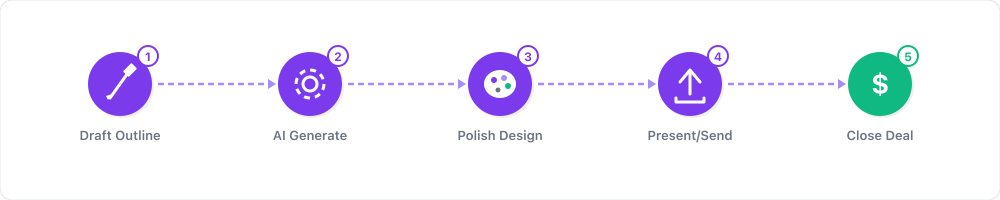
Why Selling AI-Generated Presentations Works in 2026
The presentation economy is enormous, underserved, and perfectly suited for AI-powered production. Over 35 million presentations are created every single day worldwide. Businesses, startups, educators, students, consultants, and nonprofits all need them constantly. And yet, most people dread making presentations — they spend hours wrestling with layouts, hunting for stock images, and trying to make their slides look professional instead of focusing on their actual message.
This gap between universal demand and widespread reluctance is your opportunity. Gamma has grown to over 70 million users who have created more than 400 million presentations on the platform, generating over $100 million in annual recurring revenue. Those numbers confirm two things: the demand is massive, and AI-generated presentations have achieved the quality threshold where professionals trust them for real work.
The economics of this business model are exceptionally favorable. With Gamma, you can create a polished, professional presentation in 5–10 minutes that would take a traditional designer 2–4 hours. But the client still values the output at $50–500 depending on complexity. That gap between your production cost (minutes of time) and the customer's perceived value (hours of designer work saved) is your profit margin — and it is substantial.
The market is expanding, not contracting. Template marketplaces like Etsy and Gumroad report that presentation templates are among their fastest-growing digital product categories. The rise of AI tools has not killed demand — it has expanded the market by enabling more people to offer presentation services at accessible price points while maintaining professional quality. Startups that once could not afford a $2,000 pitch deck design can now get a professional version for $100–300 from a Gamma-powered freelancer.
The presentation services market also has strong recurring demand. Unlike a one-time product purchase, businesses need new presentations constantly — quarterly reports, sales proposals, investor updates, training materials, product launches, and conference talks. Clients who buy one presentation from you often need another within weeks. This creates a natural path to recurring revenue and retainer relationships.
Gamma's specific advantages make it the ideal tool for this business. The AI generates complete presentations from a text prompt in under three minutes, handling layout, imagery, icons, and formatting automatically. The card-based responsive format means every presentation looks perfect on desktop, tablet, and mobile without manual resizing. Built-in engagement analytics let you track who viewed a presentation and which sections held their attention — a feature that adds tremendous value for sales decks and pitch presentations. And the platform's API enables automated report generation, unlocking high-value B2B services.
What You Need to Get Started
Setting up properly from the beginning ensures consistent quality and efficient production as you scale.
Accounts needed:
- Gamma account — free tier gives you 400 AI credits (enough for 15–20 full presentations). Plus at $10/month removes branding, Pro at $20/month gives unlimited AI credits
- Gumroad account — free to create, percentage taken per sale
- Etsy seller account — $0.20 per listing fee, no monthly subscription
- LinkedIn account — essential for finding freelance presentation clients
- Fiverr or Upwork account — for listing presentation design services
Hardware:
- Any computer with a web browser — Gamma runs entirely in the cloud
- Reliable internet connection
- Second monitor recommended for efficient template creation (side-by-side reference and design)
Skills needed:
- Understanding of presentation structure and storytelling (what makes a deck persuasive)
- Basic visual design sense (color coordination, typography readability, layout balance)
- Knowledge of your target niche's specific needs (what sections a pitch deck needs vs. a marketing report)
- Etsy and Gumroad SEO fundamentals
Optional but valuable:
- Experience with business presentations (consulting, startups, marketing)
- Smartmockups or Placeit for professional listing images
- A portfolio website (even a simple one-page site) for credibility with freelance clients
- Familiarity with PowerPoint and Google Slides (for export compatibility and client flexibility)
Step 1: Choose Your Presentation Niche

The presentation market is broad enough that niching down is essential. A "general business presentation template" competes with thousands of existing options and free alternatives. A "SaaS Series A Pitch Deck with Financial Model Slides" competes with a handful and targets buyers willing to pay premium prices.
Most profitable presentation niches in 2026:
| Niche | Target Buyer | Template Price | Service Price | Competition | Recurring Potential |
|---|---|---|---|---|---|
| Startup pitch decks | Founders raising seed–Series B | $25–50 | $200–500 | Medium | Low (one-time) |
| Sales proposals and decks | Account executives, sales teams | $15–30 | $100–250 | Low | High (monthly) |
| Marketing reports | Marketing managers, agencies | $15–30 | $100–200 | Low | Very high (quarterly) |
| Consulting deliverables | Consultants, advisory firms | $25–50 | $150–400 | Low | High (per project) |
| Course and training slides | Online course creators, corporate trainers | $20–40/pack | $50–150/module | Low | High (per course) |
| Nonprofit proposals | Grant writers, nonprofit directors | $20–35 | $100–300 | Very low | Medium (seasonal) |
| Real estate presentations | Agents, brokerages, developers | $10–20 | $75–150 | Medium | High (per listing) |
| Corporate internal comms | HR, operations, internal comms teams | $15–25 | $100–200 | Very low | Very high (ongoing) |
| Conference and keynote talks | Speakers, thought leaders | $25–50 | $200–500 | Low | Medium (per event) |
| Product launch decks | Product managers, startup teams | $20–35 | $150–350 | Low | Medium |
Niche selection strategy: Choose based on three criteria: (1) buyers who actively need presentations and will pay for them, (2) a use case you understand well enough to create realistic sample content, and (3) low competition on Etsy and Gumroad verified by search.
Recommended starting niches for beginners:
- Startup pitch decks — high price tolerance, clear structure, buyers who understand the value of professional presentation
- Marketing reports — recurring demand (quarterly reports), low competition, straightforward to create
- Course slides — large buyer pool (millions of online course creators), easy to produce in batches, natural bundle opportunity
Step 2: Create Presentation Templates in Gamma
Open Gamma and follow this production workflow for consistently high-quality output.
Template creation process:
-
Research your competition. Search Etsy, Gumroad, and Creative Market for existing templates in your niche. Study the top sellers: how many slides do they include? What sections? What visual style? What do reviewers praise or criticize? Your templates must meet or exceed the current standard.
-
Define the template structure. Every niche has an expected presentation structure. Deviating from it makes your template less useful. Here are the standard structures:
Pitch Deck Outline Template (8 Slides):
Slide 1: Cover Company name, one-line description, founding year, and a compelling hero image or product screenshot. Keep it clean and confident.
Slide 2: Problem Define the problem your target customer faces. Use a specific, relatable scenario. Include one data point that quantifies the pain (e.g., "Companies lose $X billion annually to...").
Slide 3: Solution Show how your product solves the problem. Include a product screenshot or demo visual. Keep the text to 3–4 bullet points maximum. The visual should do the heavy lifting.
Slide 4: Market Opportunity TAM, SAM, SOM breakdown with dollar figures. Include a simple market size graphic. Cite your data sources. Investors will verify these numbers.
Slide 5: Business Model How you make money. Pricing tiers, revenue streams, unit economics. Include your current or projected MRR/ARR if applicable.
Slide 6: Traction and Milestones What you have achieved so far. Revenue growth chart, user growth, key partnerships, notable customers, press coverage. This is your credibility slide.
Slide 7: Team Headshots, names, titles, and 1-line bios for founding team. Highlight relevant experience. Include advisory board if notable.
Slide 8: The Ask How much you are raising, what the funds will be used for (hiring, product development, marketing), and your target timeline. Include contact information and next steps.
-
Generate the first draft in Gamma. Type your template outline into Gamma's AI prompt. Be specific: "Create a 10-slide SaaS pitch deck with cover slide, problem, solution, market size with TAM/SAM/SOM, business model, traction chart, team, financials, the ask, and appendix. Use a modern, professional style with a dark navy color scheme." Gamma generates the complete initial version in 2–3 minutes.
-
Customize and polish aggressively. The AI draft is a starting point, not a finished product. Replace every generic placeholder with realistic sample content. Adjust colors to a cohesive palette. Ensure typography is consistent and readable. Add charts, data visualizations, and icons that match the niche. Insert realistic company names, financial figures, and market data. The goal is a template that looks like a real, completed presentation — not a blank skeleton with "Your text here" on every slide.
-
Create 2–3 color variations. For each template, create light, dark, and branded color scheme versions. A dark navy version, a clean white version, and a bold accent color version give buyers options and triple your product count with minimal additional work.
-
Prepare deliverables. Save the Gamma link (for buyers who want to use Gamma directly), export a PDF version (for preview and offline viewing), and if possible, export a PowerPoint/Google Slides version (many buyers prefer traditional formats). Including multiple format options significantly increases perceived value.
Quality checklist before listing:
- Every card has realistic, niche-appropriate sample content
- Typography is consistent (no more than 2 font families)
- Color palette uses 3–4 colors consistently across all cards
- Images and icons are high quality and match the professional tone
- Template includes 10–15+ cards minimum for strong perceived value
- Charts and data visualizations use realistic sample data
- The template tells a coherent story from first slide to last
Step 3: Set Up Sales Channels and Listing Optimization
You need both Gumroad (for direct sales with higher margins) and Etsy (for built-in marketplace traffic). Each platform serves a different buyer discovery model.
Gumroad setup: Gumroad works best when you drive your own traffic through social media, SEO, or email marketing. You control pricing, own the customer email address, and can offer discount codes, bundles, and automated email follow-ups. Gumroad charges a flat transaction fee (10% on the free plan, less on paid plans). Set up your Gumroad profile with a professional bio, your niche focus, and links to your best templates as featured products.
Etsy setup: Etsy is a marketplace with built-in search traffic — buyers come specifically looking for templates. You benefit from Etsy's audience even with zero followers. Etsy charges listing fees ($0.20 per listing) and transaction fees (~6.5%). The exposure is worth the fees for new sellers who lack their own audience.
Listing optimization — the conversion multiplier:
Title (140 characters on Etsy, use them all): Front-load the highest-volume keywords. Include the template type, niche, use case, and format. Example: "Pitch Deck Template | Startup Investor Presentation | Fundraising Slides | Gamma AI | PowerPoint Alternative | Editable Deck Template"
Listing images (8–10 per listing):
- Hero mockup — the presentation displayed on a laptop in a clean workspace
- Full overview — all slides shown in a grid layout
- Individual slide close-ups (3–4 best slides shown in detail)
- Before/after comparison — generic slides vs. your polished template
- Device mockup — the presentation on a tablet and phone (showing responsive layout)
- What's included — visual checklist of all formats and deliverables
- How it works — 3-step visual guide (purchase, open link, customize)
- Color variations — show all available color scheme options
Description structure (250+ words): Open with the buyer's problem (spending hours on presentations), introduce your solution (a ready-to-customize template), list everything included (number of slides, formats, color options), explain how to access and customize, describe who it is perfect for, and close with a link to related templates.
Pricing strategy:
- Individual templates: $15–25 (start at $15 for your first 10 listings to build reviews)
- Bundle of 3–5 related templates: $39–59 (35–45% discount vs. individual)
- Mega bundle (10+ templates): $79–119 (highest AOV product in your shop)
- Customization add-on: $50–150 on top of template price
Design Service Pricing Sheet:
Service Deliverables Price Turnaround Custom presentation (10–15 slides) Fully designed deck, your content, 2 revision rounds, Gamma link + PDF $100–250 2–3 days Startup pitch deck (full service) 10–12 slides, financial model slide, appendix, 3 revision rounds, all formats $300–500 3–5 days Quarterly report template Customized for your metrics, chart templates, brand colors, reusable format $150–300 3–5 days Course slide package (10 modules) 10 module decks, consistent styling, instructor notes, student handout versions $500–1,500 7–14 days Monthly report retainer 4 reports/month, branded template, data visualization, analytics setup $400–800/month Ongoing Presentation training + template setup 1-hour training session, 3 custom templates, brand style guide $200–400 Scheduled All packages include:
- Gamma link for easy future editing
- PDF export for offline viewing
- PowerPoint/Google Slides version when possible
- 2 revision rounds (additional revisions $50/round)
- Commercial usage rights
- 30 days of email support for questions
Step 4: Build Your Freelance Presentation Service
Templates are excellent for passive income, but freelance presentation services generate higher revenue per project and lead to recurring client relationships. The two revenue streams complement each other perfectly.
Positioning your service: You are not selling "AI-generated slides." You are selling professional presentation design delivered with exceptional speed and at accessible prices. Clients care about the result — a polished, persuasive deck — not the tools you use to create it. Lead with the outcome, not the process.
Client acquisition channels:
-
Fiverr — Create a gig titled "I will design a professional presentation, pitch deck, or sales proposal." Start at $50–75 to build reviews quickly. After 10+ five-star reviews, raise prices to $100–250. Fiverr's algorithm rewards sellers who deliver quickly — Gamma's speed gives you a massive advantage here.
-
Upwork — Target longer proposals and search for jobs like "need pitch deck designer," "presentation template creation," and "quarterly report design." Upwork clients tend to pay more per project than Fiverr and are more likely to become repeat customers.
-
LinkedIn — Position yourself as a presentation design specialist. Share before-and-after examples, presentation tips, and case studies. Connect with startup founders, marketing managers, and consultants who need presentations regularly. LinkedIn is the best channel for landing $300–500+ pitch deck projects.
-
Direct outreach — Identify startups that recently raised funding (they will need investor update decks), agencies that produce client reports, and consultants who deliver recommendations via presentation. Send a brief email with a sample deck relevant to their industry and a link to your portfolio.
Service delivery workflow with Gamma:
- Client brief: Receive content outline, brand guidelines, and any existing materials (15 min)
- Generate initial draft in Gamma using client's content (5–10 min)
- Customize, polish, and brand the presentation (30–60 min)
- Client review and revision round 1 (wait for feedback)
- Implement revisions (15–30 min)
- Deliver final version in all formats (Gamma link, PDF, PPTX)
Total active work time: 60–120 minutes for a presentation you charge $100–300. That is $50–150 per hour effective rate — competitive with senior freelance designers.
Step 5: Scale with Systems, Bundles, and Automation
Once you have your first 10–15 listings generating sales and initial client projects coming in, shift to systematic scaling.
Template production system: Block 3–4 hours per week for template creation. In that time, you should be able to:
- Create 2–3 new complete templates in Gamma (10–15 minutes AI generation + 30–45 minutes customization each)
- Prepare listing images and mockups for each
- Write and publish optimized listings
Target 8–12 new templates per month. Within 6 months, you will have 50–75 listings generating consistent daily sales.
Bundle strategy for maximum revenue: Bundles dramatically increase your average order value. Once you have 5+ templates in a niche, create bundles:
- "Complete Startup Package" — pitch deck + investor update + product launch + company overview ($49–69)
- "Marketing Report Bundle" — quarterly report + campaign recap + social media report + annual review ($39–59)
- "Course Creator Kit" — module slides + course intro + student workbook + certificate template ($49–79)
Customization upsells: Add a customization service as an add-on to every template listing. "Want this template customized to your brand colors, logo, and content? Add the customization package for $50–150." This converts a $20 template sale into a $70–170 order. Approximately 10–15% of template buyers will purchase the customization add-on.
Recurring revenue through retainer clients: The highest-value outcome of your freelance work is converting one-time clients into monthly retainers. Businesses that need quarterly reports, monthly investor updates, or regular sales proposals are perfect retainer candidates. A $400–800/month retainer for 4–8 presentations per month provides stable, predictable income.
API-powered automated reporting (advanced): Gamma offers API access on the Pro plan. This enables you to build automated report generation services — a client's data feeds into a template, and a finished report is generated automatically. This is a premium B2B service worth $500–2,000/month per client.
Real-World Examples and Case Studies
RevUp Advisory — Eliminating Designer Dependency: RevUp Advisory, a business consulting firm, used Gamma to eliminate the need for hiring a dedicated presentation designer. The firm previously spent significant time and budget on freelance designers for client deliverables, pitch materials, and internal reports. By switching to Gamma, they maintained professional presentation quality while dramatically reducing production time and costs. The team now creates client-ready presentations in minutes instead of days. Source: gamma.app/insights
Gamma Platform Scale: Gamma has grown to over 70 million users worldwide, with more than 400 million presentations created on the platform. The company surpassed $100 million in annual recurring revenue, validating that AI-generated presentations have crossed the quality threshold for professional and business use. Over 700,000 presentations are created on Gamma every single day — a number that continues to grow as more professionals discover the platform.
Etsy Presentation Template Sellers: Presentation template sellers on Etsy and Gumroad report $500–5,000/month from libraries of 30–100+ templates. The highest earners specialize in high-value niches (pitch decks, consulting deliverables) and offer customization services alongside passive template sales. Sellers who combine template sales with freelance services typically earn 2–3x more than those who sell templates alone.
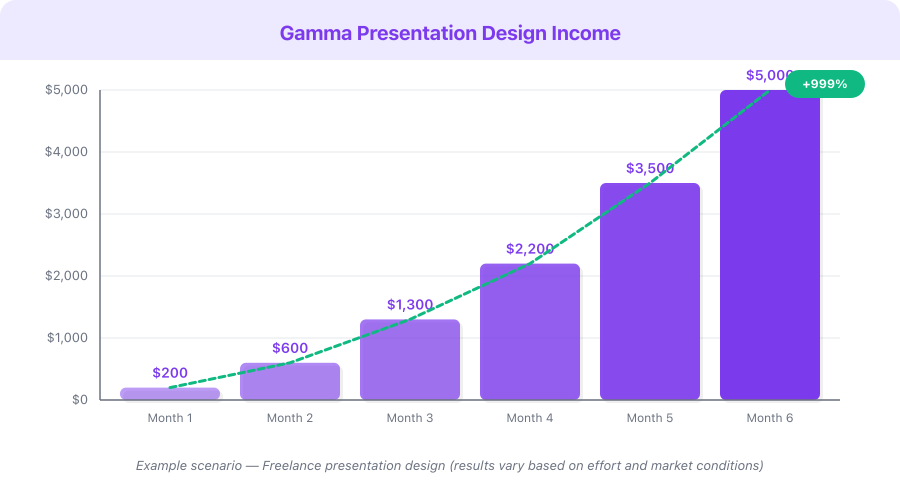
Revenue Projection — Building a Presentation Business:
| Month | Templates | Service Clients | Template Revenue | Service Revenue | Total Monthly |
|---|---|---|---|---|---|
| 1 | 5–10 | 1–2 | $75–250 | $100–400 | $175–650 |
| 3 | 20–30 | 3–5 | $300–1,000 | $400–1,500 | $700–2,500 |
| 6 | 40–60 | 5–8 | $600–2,000 | $800–3,000 | $1,400–5,000 |
| 12 | 80–120 | 8–15 | $1,200–4,500 | $1,500–6,000 | $2,700–10,500 |
This is a hypothetical example based on publicly available data, not a guarantee of results. Individual results vary significantly.
Monetization Strategies
1. Passive Template Sales — $500–5,000/month
Sell presentation templates on Etsy, Gumroad, and Creative Market. Revenue scales with catalog size and review count. Each template is a permanent asset that can sell for years. Focus on high-value niches (pitch decks, consulting deliverables) where buyers expect to pay $15–50 per template.
Dollar range: $15–50 per template, $39–119 for bundles. Target $500–5,000/month with 50–120 optimized listings across multiple niches.
2. Freelance Presentation Design — $1,000–5,000/month
Create custom presentations for businesses, startups, and consultants on Fiverr, Upwork, and LinkedIn. Gamma's speed lets you deliver in hours what traditional designers take days to produce. Focus on pitch decks ($200–500 each) and consulting deliverables ($150–400 each) for highest per-project revenue.
Dollar range: $50–500 per project depending on complexity. 5–15 projects per month generates $1,000–5,000.
3. Monthly Retainer Services — $1,000–4,000/month
Convert freelance clients into monthly retainers for recurring presentations — investor updates, quarterly reports, sales proposals, and training materials. Retainers provide stable, predictable income and compound as you add clients.
Dollar range: $300–800 per retainer client per month. 3–5 retainer clients generates $1,000–4,000/month.
4. Customization Upsells — $300–1,500/month
Offer brand customization as an add-on to every template sale. Charge $50–150 to customize colors, fonts, logo, and sample content to match the buyer's brand. This incremental revenue stacks on top of passive template income with minimal additional work.
Dollar range: $50–150 per customization. If 10–15% of template buyers upgrade, this generates $300–1,500/month on a shop doing $2,000–10,000 in template sales.
5. Automated Report Generation (B2B) — $500–3,000/month
Use Gamma's API (Pro plan) to build automated report generation pipelines for businesses. A client's data feeds into a Gamma template, and a finished branded report is generated automatically. This is a premium service for agencies, consulting firms, and companies that produce regular reports.
Dollar range: $500–2,000 per client per month. Even 1–2 B2B automation clients generates $500–3,000/month in high-margin recurring revenue.
Pricing Breakdown and ROI
| Plan | Monthly Cost | AI Credits | Key Features | Break-Even Point |
|---|---|---|---|---|
| Free | $0 | 400 (one-time) | Basic generation, Gamma branding | Already free |
| Plus | $10/mo | 400/month | No branding, custom domains, detailed analytics | 1 template sale |
| Pro | $20/mo | Unlimited | Custom fonts, API access, priority AI | 1 template or service sale |
| Ultra | $100/mo | Unlimited | Team seats, SSO, dedicated support | 3–5 service projects |
Annual billing saves ~20%: Plus drops to ~$8/month, Pro to ~$16/month.
ROI calculation for a freelancer on Gamma Pro ($20/month):
- Monthly cost: $20
- Average freelance deck price: $150
- Decks completable per week with Gamma: 5–10
- Revenue from 8 decks per month: $1,200
- Plus template sales (passive): $300–800/month
- Monthly profit: $1,480–1,980
- ROI: 7,300–9,800%
Gamma affiliate program: Gamma offers 30–50% recurring commission on referrals. If you recommend Gamma in your content, tutorials, or client interactions, each Plus subscriber referral earns you $3–5/month recurring, and each Pro subscriber referral earns you $6–10/month recurring. Creators who build audiences around presentation tips and AI productivity report $200–2,000/month in recurring affiliate commissions.
Common Mistakes
-
Filling templates with placeholder text instead of realistic content. Templates with "Insert your text here" or "Lorem ipsum" on every slide feel cheap and unprofessional. Fill them with realistic sample content — a fictional company name, actual-looking financial figures, genuine-sounding market analysis. Buyers need to see how the finished product looks, not imagine it. This single change can double your conversion rate.
-
Using flat screenshots instead of mockup images. A direct screenshot of your Gamma slides looks generic. A mockup showing the presentation on a MacBook screen in a modern conference room, or displayed on a tablet during a meeting, creates an aspirational context that drives purchases. Invest 10 minutes per listing in creating professional mockups using Smartmockups or Placeit.
-
Pricing below $15 and signaling low quality. Buyers in professional niches (pitch decks, consulting, marketing) expect to pay $15–50 for a presentation template. A $5 price tag signals amateur quality and attracts price-sensitive buyers who leave more complaints. Price with confidence — your template saves them hours of work, which is worth far more than $15–30.
-
Not creating bundles to increase average order value. Individual template sales at $20 are fine, but a "Complete Startup Bundle" at $49–69 (containing 3–5 related templates at a 35% discount) dramatically increases your revenue per transaction. Bundles should be your highest-revenue product category.
-
Ignoring Etsy and Gumroad SEO. These platforms are search engines. If your titles, tags, and descriptions do not match buyer search queries, your templates are invisible. Research keywords using Etsy autocomplete and eRank before writing each listing. "Pitch deck template" gets far more searches than "business presentation."
-
Selling templates without offering customization services. Approximately 10–15% of template buyers will pay $50–150 extra for brand customization. If you are not offering this, you are leaving significant revenue on the table. Add a customization option to every listing and advertise it in your delivery follow-up email.
-
Neglecting the freelance service side of the business. Templates generate passive income, but freelance presentation services generate 2–3x more total revenue and lead to retainer relationships worth hundreds per month. Build both revenue streams from the beginning — they reinforce each other (templates showcase your skills, services build your portfolio and client base).
Quick Start Checklist
- Sign up for Gamma free and create your first presentation to learn the interface
- Choose 1–2 niches from the table above (pitch decks and marketing reports are excellent starting points)
- Research top-selling templates on Etsy and Gumroad in your chosen niches
- Define the standard structure for your niche (use the pitch deck outline template above as a starting point)
- Create your first 3 templates in Gamma — each with 10–15+ slides, realistic sample content, and 2 color variations
- Prepare 8–10 professional mockup images per template using Smartmockups or Placeit
- Set up a Gumroad account and list your first 3 templates at $19–25 each
- Set up an Etsy shop and cross-list the same templates with fully optimized titles, tags, and descriptions
- Create a bundle product combining all 3 templates at a 35% discount ($39–49)
- Set up a Fiverr gig offering custom presentation design starting at $50–75
- Create 2–3 new templates per week for the first 3 months (target 30+ templates)
- After your first 5 service projects, reach out to past clients about monthly retainer arrangements
FAQ
How fast can I create a presentation template with Gamma?
Gamma generates a complete initial presentation from a text prompt in 2–3 minutes. Customizing and polishing that draft into a sellable template takes an additional 20–40 minutes depending on complexity. In total, you can create a finished, listing-ready presentation template in about 30–45 minutes. That speed lets you produce 2–3 templates per design session, building your catalog rapidly.
Do I need design experience to sell presentation templates?
No formal design training is needed. Gamma handles the heavy design work — layout, spacing, visual hierarchy, image selection. Your role is content structuring (knowing what sections a pitch deck or marketing report needs), quality curation (selecting the best AI-generated layouts and refining them), and listing optimization (keywords, mockups, descriptions). Understanding your niche buyer's needs matters more than design software skills.
Can I export Gamma presentations to PowerPoint?
Yes. Gamma offers PowerPoint export, though complex layouts with embedded content may not translate perfectly. For most standard presentation templates, the export is reliable and usable. Many sellers offer both the Gamma link (for Gamma users) and a downloadable PDF or PowerPoint file (for buyers who prefer traditional formats). Offering multiple formats increases your template's appeal and perceived value.
What is the best niche for selling presentation templates?
Startup pitch decks are the highest-value niche because founders have the strongest willingness to pay ($25–50 per template, $200–500 per custom deck) and the clearest need. Marketing reports and consulting deliverables are strong second choices because they have recurring demand — the same buyer needs new reports every quarter. Underserved niches like nonprofit proposals and corporate internal communications have very low competition and steady demand.
How much can I earn selling presentations with Gamma?
Template sellers with 30–60 listings typically earn $500–2,500/month. Adding freelance presentation services increases total income to $1,500–5,000/month. Sellers who build retainer relationships with 3–5 regular clients can reach $3,000–10,000/month. The key variables are catalog size, niche selection, listing quality, and whether you actively pursue service clients alongside passive template sales.
What's Next
You now have a complete system for building a profitable presentation business with Gamma. Here are your recommended next steps:
- Read our Gamma Review for a detailed look at every feature, AI capabilities, and honest pros and cons
- Check our Gamma Pricing breakdown to choose the right plan as you scale from free to paid
- Explore Canva for creating mockup images, supplementary design assets, and social media promotions for your template shop
- Consider Kittl if you want to expand into print-on-demand merchandise as an adjacent revenue stream
Start today. Sign up for Gamma, pick your niche, and create your first presentation template. List it on Gumroad and Etsy with professional mockups and optimized keywords this week. Then create 2 more next week. The compound effect of a growing template catalog, accumulating reviews, and expanding search visibility is how presentation sellers build $2,000–10,000/month income streams.
Try Gamma free — your first professional template is 10 minutes away.